We have all the answers when it comes to freshwater fishing throughout New Zealand.
You’ll find answers to some key questions below.
Remember, if you can't find what you are looking for, or for more information on any topic, please contact your local Fish & Game office, email the New Zealand Council or select here to fill in a question form..
There are ten different types of fishing licence to cater for all needs.
The family licence is to encourage families to head out fishing.
The licence allows adult spouse/partners and their children or grandchildren (who are under 18 years of age on October 1) to fish.
Key facts:
- Both adults can fish independently (previously the secondary holder could only fish with the primary holder or children)
- Family participants (children/grandchildren) may only fish when accompanied by either Adult Licence Holder
- Voting rights and eligibility to stand in elections are extended to both adults • Communications will go to both adults (from 2026/27)
- Spouse or partners aged 65 or older, who were secondary licence holders on the Family Licence in the past, can claim continuous history based on the primary licence to be eligible for the Loyal Senior Licence. Please contact your regional Fish & Game office to assist with this transition.
Read the key changes for 25/26 fishing season here.
For information on cost and other licences, click here.
- Both adult spouses/partners will receive their own named licence card, have equal fishing rights, and can fish independently
- Both adults have voting rights and can stand in Fish & Game elections
- Both adults will receive Fish & Game communications (from 2026/27)
- Removes restrictions that previously limited participation for secondary licence holders, most of whom were women
- Makes it easier for families to enjoy fishing together or separately
- Both adults will receive a plastic licence card and need to carry it with them. Or they can use a PDF licence either printed or on a phone but they must carry photo ID as well
Women represent a huge opportunity to grow fishing participation. Our data shows that 13% of individual licence holders are women, but this figure increases to around 30% when we consider the number included under the previous secondary family licence holder category. These changes make it easier for women to get involved by removing barriers and making fishing more accessible to all family members. Increasing women’s participation to the same rate as men would see 40,000 to 60,000 additional women anglers.
Under the new regulations, at least one child or grandchild must be named on the licence. If there are no children or grandchildren to include, they will need to purchase individual adult licences. The child must be aged 18 or under as of October 1st, live with them ordinarily or periodically, or are their grandchildren. A maximum of four children/grandchildren can be covered. Children or grandchildren over the age of 18 on October 1 cannot be included on the family licence and will need to purchase their own adult licence. This ensures the family licence remains focused on its core purpose of introducing young people to fishing.
The winter fishing season starts on 1 April and lasts until 30 September of that same year.
To fish a Designated Waters Fishery a Designated Waters Licence is required.
First, you must get one of these qualifying Whole Season Sports Fishing Licences:
- Whole Season (Adult, Junior or Child)
-
Family
- Loyal Senior
- Local Area (only qualifies for an endorsement in that region)
- Non-Resident
If you are a visitor from overseas, you must purchase a Non-Resident Licence.
Once you have bought a qualifying licence you can purchase a Designated Waters Licence
Currently, there are six Fish & Game regions in New Zealand with Designated Waters fisheries; Wellington, Nelson/Marlborough, North Canterbury, West Coast, Otago and Southland.
In 2023 Fish & Game introduced the Designated Waters Licence to replace the Backcountry Endorsement.
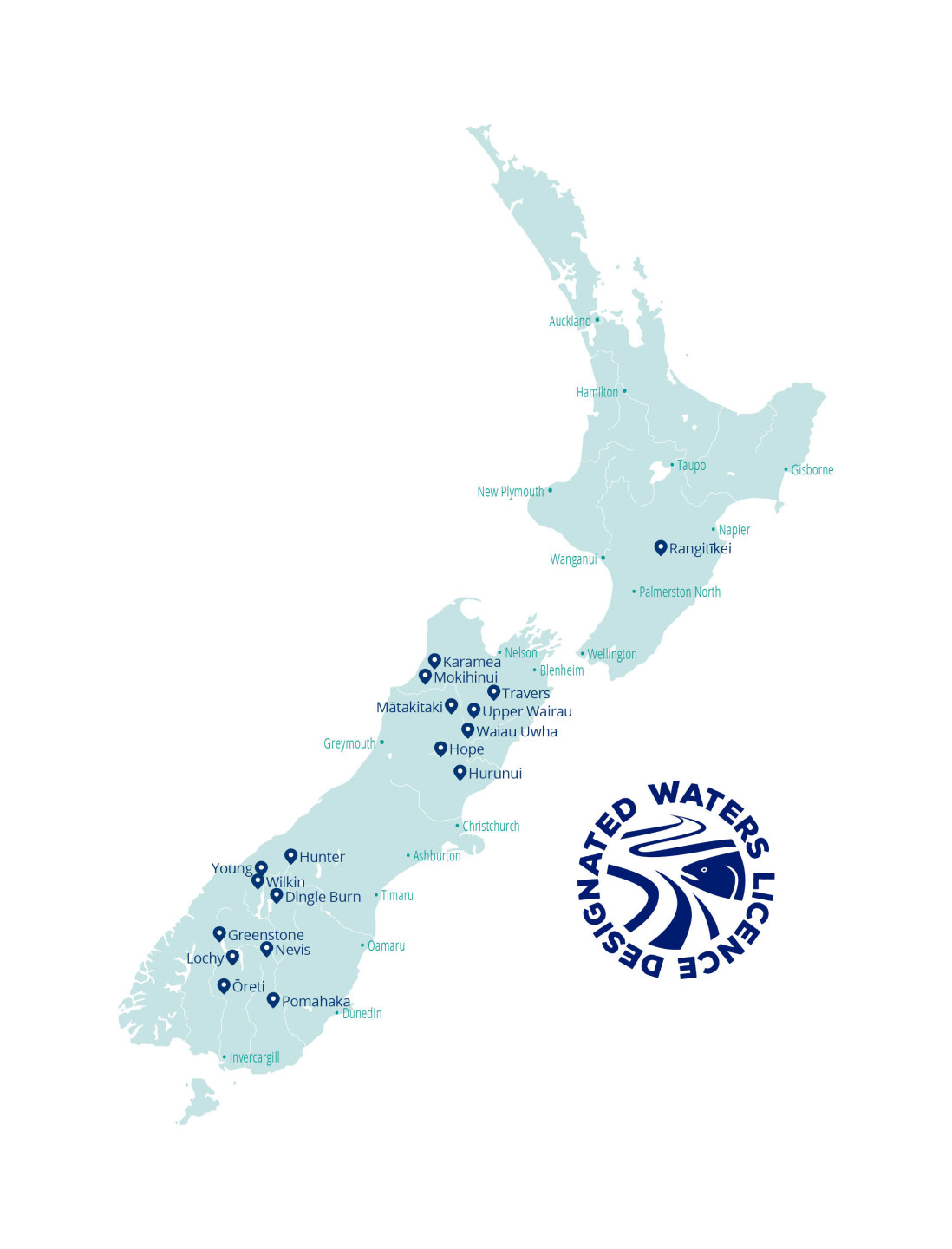
Click on the map to download a larger version
Please select here to view more information regarding areas.
In 2023 Fish & Game introduced the Designated Waters Licence to replace the Backcountry Endorsement.

Click on the map to download a larger version
Over the previous ten years, Fish & Game had received an increasing number of complaints from anglers regarding overcrowding on a small number of fragile fisheries. Unsustainable angling pressure on these fisheries detrimentally affects both the angling experience (sense of wilderness feeling/solitude) and trout behaviour (visibility and catchability). Fish & Game have termed these fisheries ‘pressure sensitive fisheries’.
In most cases, pressure-sensitive fisheries share these common features:
- Almost exclusively rivers
- Clear water
- Excellent sight fishing
- Large average size of fish
- High scenic value
- Often in a wilderness or backcountry setting
- Largely located in the South Island
- High levels of non-resident angler use
Please select here to view the areas that can be fished with a Designated Water Licence.
A Controlled Fishery Licence is required to fish:
- on the Upper Greenstone River (and its tributary streams) in Otago during the period between 1st February and 31 March.
- the Ettrick Burn during the period between 1 November and 31 May.
- the Clinton and Worsley rivers during the period between 1 November and 31 May
- the Ōhau River from its confluence with Lake Ruataniwha upstream to the Lake Ōhau Weir.
Angling opportunity is limited during that time so that anglers can have a reach of the river or ‘beat’ to themselves for a one or two day period.
The aim of this restriction is to preserve the quality of angling experience by limiting angler density. Licences are obtainable through an online booking system which operates five days in advance. A back country endorsement is required to enter the online booking area.
Please select here to view more information.
Enquiries about Controlled Fishery Licences should be directed to otago@fishandgame.org.nz or (03) 4779076 for Otago or southland@fishandgame.org.nz or (03) 2159117 for Southland.
You may be able to upgrade your licence under certain conditions (see contact details below) but only within the same calendar month in which the licence was purchased.
If you have purchased a licence from a “retailer” then contact your local Fish & Game office who will advise the conditions under which you may be able to upgrade your licence. For contact details go to the Fish & Game website homepage, click the regions link at the top of the page, choose your region, open the menu and then click the 'Contact' link in the navigation column.
If you purchased your licence “online” on the Fish & Game website then contact the Fish & Game Licensing Administrator by email or call their freephone number 0800 542 362. They will advise the conditions under which you may be able to upgrade your licence.
Eight of the nine licence types cover all Fish & Game regions around New Zealand except Taupo, which is managed by the Department of Conservation.
Part season licences – One Day, Short Break and Long Break and Winter licences – all allow you to fish everywhere but the Taupo fishery.
All the full season licences except Local Area also allow you to fish everywhere but Taupo.
The Local Area Licence only allows you to fish in one region chosen when you buy it – and not outside that region.
Sports Fish: The Freshwater Fisheries Regulations 1983 Schedule 1 defines the following species as “sports fish”:
- Brown trout (Salmo trutta):
- Rainbow trout (Oncorhynchus mykiss, formerly known as Salmo gairdneri):
- American brook trout or char (Salvelinus fontinalis):
- Lake trout or char (Salvelinus namaycush):
- Atlantic salmon (Salmo salar):
- Quinnat or chinook salmon (Oncorhynchus tshawytscha):
- Sockeye salmon (Oncorhynchus nerka):
- Perch (Perca fluviatilis):
- Tench (Tinca tinca):
- Rudd (Scardinius erythrophthalmus) found or taken in the Auckland Acclimatisation District—
and includes any hybrid and the young, fry, ova, and spawn, and any part of any such fish; but does not include salmon preserved in cans and imported into New Zealand.
Contact the Department of Conservation Turangi Office on 07-386 8607– or visit http://www.doc.govt.nz and click on fishing licences. Taupo fishing licences are available from sports shops in the Taupo area.