We Encourage Best-Practice Catch and Release
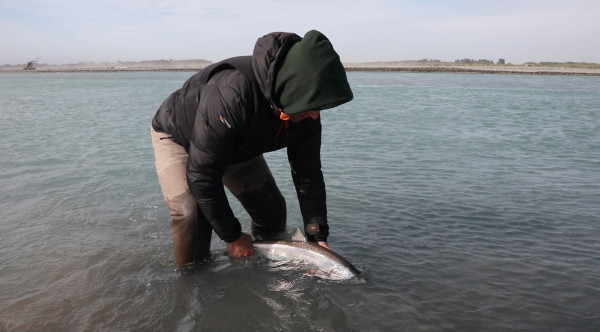
With the sea-run salmon population in crisis and with the season bag limit of one fish in place, more than ever before, anglers may choose to catch and release sea-run salmon.
The catching and releasing parts are common practice; it’s the “care for the landed fish” part in between that is important to do really well to ensure a successful release. We are encouraging anglers to up their skills and use best-practice techniques for handling salmon.
Some anglers may practice catch and release as an intended conservation tool, as it may potentially allow more salmon to reach the spawning grounds. Other anglers may practice catch and release to enable them to continue to remain actively fishing for the season, as once an angler has kept their one sea-run salmon season bag limit, their season ends. There are also some legal requirements where you must release a sea-run salmon, e.g. You cannot continue to fish after having caught your season bag limit.
Best-practice catch and release techniques take knowledge and experience to perfect. When done well, it will often result in a healthy fish reaching the spawning grounds.
Poor catch and release that fails to care for the fish has a high chance of causing injury and or death; therefore, it can impact the sea-run salmon fishery. In the case that an angler fails to care for a salmon, we suggest it’s better to keep it as their one fish season bag limit.
As catch and release is a new mindset and skill for many salmon anglers, we want to help you become a catch and release expert by sharing Central South Island and North Canterbury Fish & Game’s best-practice catch and release three key principles and top tips to achieve these.
Best Practice C&R for Sea-Run Salmon: Three Key Principles
Top Tips for the Best Practice C&R for the Sea-Run Salmon: Three Key Principles
Principle 1: Keep Salmon in the Water While Unhooking
Why:
- Salmon only breathe dissolved oxygen in the water. Keeping them in the water is vital for proper recovery after the intense exertion of the fight and is essential for their survival.
- Holding a salmon out of the water prevents its ability to breathe and recover, and can lead to death if done for too long.
How:
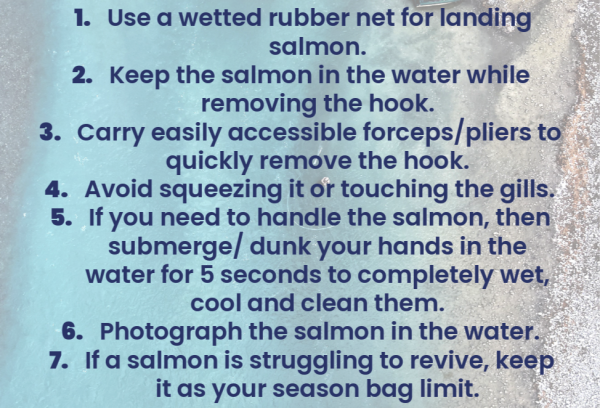
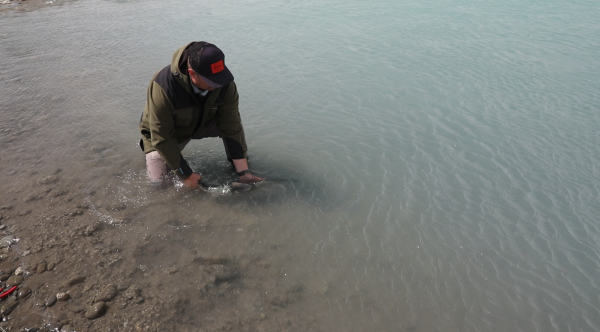
- To greatly improve a salmon’s chance of surviving release, anglers should keep its mouth and gills submerged under the water as much as possible.
- If you need to remove the salmon from the water, make it quick - the fish should not be out of the water for more than 5 seconds.
- Use a rubber landing net for salmon fishing – it’s easier to keep salmon in the water if you have a net.
Principle 2: Wet Your Hands Before Handling Salmon
Why:
- Salmon have a layer of protective mucus (slime) and scales that protect them from disease. If they come into contact with surfaces that are hot, dry, hard, or rough (such as dry hands, sharp rocks and sun-baked sand), this can remove their protective layer, which makes them more susceptible to diseases, especially fungal infections, which can lead to death.
How:
- If you need to handle the salmon, then submerge/ dunk your hands in the water for 5 seconds to completely wet, cool and clean them.
- Use a rubber landing net for salmon fishing – rubber nets are less abrasive than knotted rope mesh nets, which do more damage to salmon’s slime, scales, fins, and gills.
Principle 3: Reduce the Handling Time of Salmon
Why:
- The longer it takes, the less chance of survival they have. Handling is stressful for salmon, which are already in a state of “fight or flight” response triggered during being caught, and it can take hours for them to fully recover after release.
- As soon as you land the salmon, you need to work quickly and efficiently to release it as soon as possible.
- If the salmon is energetic and active, you should be able to release it without needing to handle it to aid in its revival.
How:
- Use a rubber landing net for salmon fishing - hooks don't snag as much on rubber nets, which can help reduce handling time.
- If you need to handle the salmon, avoid squeezing or touching the gills.
- Minimise or avoid photography to reduce handling time. If you want to take photos of your salmon, do so with it in the net while in the water - forget about the classic “grip and grin fishing photo”– this can be very hazardous and can lead to the salmon panicking and then falling onto the hot, dry ground, etc.
- Carry easily accessible forceps and/or pliers to quickly remove the hook.
- Use single hooks for quick dehooking and even consider crimping the barb to quickly remove the hook and reduce handling time.
Please try to follow these 3 best-practice catch and release key principles to greatly improve the chance of a salmon’s healthy survival.
When do I keep my salmon if I cannot perform best-practice catch and release?
- If a fish is badly injured, it has a very low chance of survival (e.g., bleeding heavily from gills, eyes, or oesophagus (hooked deep in the mouth, or suffering spinal damage), it should be kept.
- If a salmon is struggling to recover for release, try reviving it by facing into the river current, and if it can’t swim off under its own strength after 5 minutes of attempting to revive it, then you should keep it.
- If the salmon experiences prolonged contact with dry, hard, or rough surfaces (such as dry hands, rocks and sand), you should keep it.
- If a salmon is deeply hooked, where you cannot remove the hook without causing more damage to the salmon’s mouth and oesophagus, then you should keep it.
- Best-practice catch and release is not generally achievable when fishing for salmon in the surf, therefore anglers who fish for salmon in the surf should take a harvest-only approach. The main reasons being that you can’t safely keep the fish in the water while removing the hook in the surf, due to the hazard of waves. The unfortunate outcome is that surf anglers end up dragging the fish up the beach to keep themselves safe. They then remove the hook and then walk the fish over to the lagoon away from the waves or throw the salmon back out into the waves. That can take anywhere from 30 seconds to 5 minutes with the fish out of the water, and cause the fish to come into contact with sharp and hot stones and sand. In this scenario, the best practice three key principles are not achievable, and therefore, you should keep the salmon.
- Anglers practising catch and release should avoid fishing during periods of high-water temperatures in summer. Water temperatures are at their hottest in the afternoon and evenings. Overseas studies suggest that as water temperatures increase, stress from catch and release can cause increased mortality.
Do the regulations protect fish from poor catch and release?
Anglers should be aware that poor catch and release technique can result in the angler committing an offence under the Conservation Act 1987. In the Sports Fishing Regulations under the Second Schedule - Central South Island Fish & Game and North Canterbury regions - 2 Additional Requirements - Note 1.5 – “Any angler who lands a sports fish that will not be kept shall immediately return it with as little injury as possible into the water from which it was taken.” Therefore, please keep in mind that it is a legal requirement that if you do not intend to keep the salmon you catch, you must immediately return it with as little injury as possible into the water from which it was taken. So, if you cannot perform best practice catch and release techniques effectively to ensure the salmon has the greatest chance of survival, we recommend you keep it.
When am I legally required to release a sea-run salmon?
- If you don’t hold a sea-run salmon licence.
- If you cannot immediately fill out your sea-run salmon season bag card after landing a salmon.
- If you have already filled your sea-run salmon season bag limit for the season.
- If a sea-run salmon does not exceed this minimum size limit of 300mm.
- If a sea-run salmon is foul-hooked.