North Canterbury Fishing Report - 19th March 2026
- North Canterbury
- 19/03/2026
- Jackson Meecham
Fighting back for salmon: major wetland restoration opens as pressure on Rakaia fishery mounts
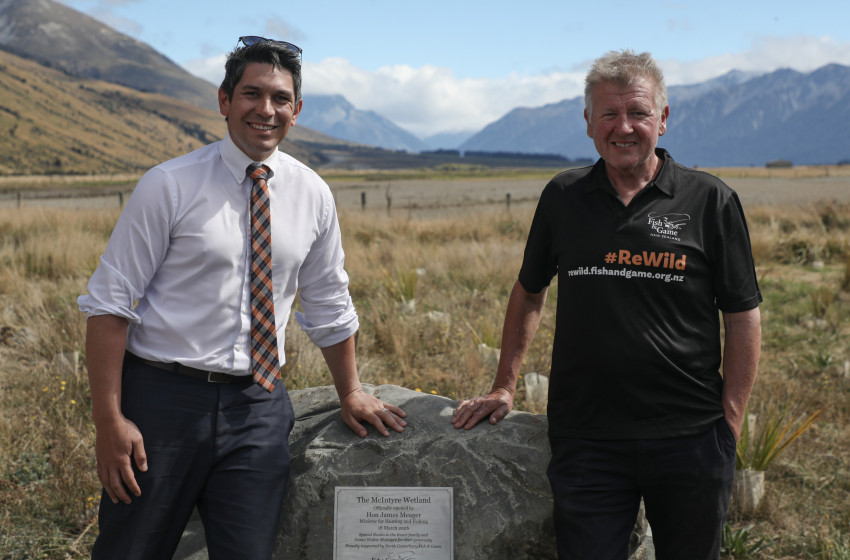
Image Above: Minister of Hunting and Fishing James Meager and Fish & Game Field Officer Steve Terry at the McIntyre Wetland opening in the North Canterbury High Country on the 18th of March 2026.
Fish & Game yesterday celebrated the opening of a restored wetland to protect a critical salmon spawning site on one of New Zealand’s iconic rivers. Chinook salmon numbers are at historic lows on the Rakaia River and anglers are facing tight restrictions on the number of fish they can catch.
Now, a project to restore Glenariffe Stream in the upper Rakaia catchment will add to the safeguarding of more than 380 hectares of high-country streams and wetlands, six times the project’s original target.

An aerial shot of the East Branch of Glenariffe Stream that has now been returned to its original course through this project.
Glenariffe Stream contributes around 18% of the wild Chinook salmon that return to spawn in the Rakaia River, however its East Branch had been diverted for 70 years to drain farmland. As part of the project, the East Branch has now been returned to its original course, restoring 44 hectares of wetland habitat and protecting an important spawning site.

Minister of Hunting and Fishing James Meager speaks alongside North Canterbury Fish & Game Council Chairman Alan Strong at the McIntyre Wetland opening in the North Canterbury High Country on the 18th of March 2026.
Minister for Hunting and Fishing James Meager today officially opened the site, named the McIntyre Wetland in recognition of a generous $550,000 bequest from the late James McIntyre, dedicated to restoring sea-run salmon in the Waimakariri and Rakaia rivers. “Restoring habitats like the McIntyre Wetland is a crucial step in securing the future of our wild salmon. This project demonstrates what can be achieved when communities, landowners, and government work together for conservation,” he said.
North Canterbury Fish & Game project manager Steve Terry, who has led the restoration effort from the outset, says protecting spawning habitat is one of the few levers available to help the fishery recover. “Salmon numbers are at historic lows, not just in Canterbury but across New Zealand’s East Coast rivers, with unfavourable, warmer ocean conditions among the key drivers of decline."
“We can’t control the ocean, and we can’t control the climate - but we can make sure that when salmon do return to the Rakaia to spawn, their offspring have the best possible habitat waiting for them."
“Glenariffe Stream is one of the river’s most significant spawning tributaries, and for 70 years it simply wasn’t functioning as it should. Getting it back to its natural course is a major step forward for the fishery.”

Belinda Bull, Mark Ensor, Steve Terry, James Meager, Corina Jordan and Alan Strong (left to right) at the McIntyre Wetland opening in the North Canterbury High Country on the 18th of March 2026.
The project was made possible by $784,000 from the Ministry for the Environment’s Freshwater Improvement Fund. Key were partnerships with four high-country stations – Glenariffe, Double Hill, Mt Algidus, and Redcliffes. Environment Canterbury, the Cawthron Institute, Manawa Energy, Rakaia River Fishing Promotions, and the QEII Trust also supported the project.
Fish & Game New Zealand Chief Operating Officer Richie Cosgrove says the decline in salmon numbers makes projects like this more important than ever. “Projects like this, protecting and restoring critical spawning habitats, gives the salmon fishery help it really needs. The scale of what’s been achieved here, 380 hectares secured against an original target of 60, is a testament to Steve Terry’s persistence and the willingness of high-country landowners to be partners in conservation.”

Minister of Hunting and Fishing James Meager and Fish & Game Field Officer Steve Terry plant native plants at the McIntyre Wetland opening in the North Canterbury High Country on the 18th of March 2026.
Beyond Glenariffe, the project has secured significant habitat protection across the catchment:
- Double Hill Station: 77 hectares of wetlands and waterways retired, with 11.3km of new fencing
- Mt Algidus Station: A 200+ hectare QEII covenant protecting the Hydra Waters, a complex of spring-fed streams and wetlands accounting for 20–30% of Rakaia salmon spawning
- Redcliffes Station: 59+ hectares of wetlands and native scrub retired from farming
The McIntyre Wetland will now be managed for long-term restoration, with ongoing planting, riparian management, and ecological monitoring planned in the years ahead.

To watch the speeches at yesterday's McIntyre Wetland opening, please click the video above. (Sound has some issues due to feedback from the speaker)
Don't Miss An Update Make Sure Your Following Us In All The Right Places!


Applications to join Environment Canterbury’s Biosecurity Advisory Groups open on Monday, 2 March, providing an opportunity for community members to help shape how pests are managed across Waitaha Canterbury. Biosecurity Advisory Groups work closely with Environment Canterbury to support the objectives of the Canterbury Regional Pest Management Plan, contributing community insight, local knowledge, and practical experience to protect the region’s economy, cultural values, and recreational spaces.
The groups provide advice on pest management priorities, help raise awareness about how pests spread, and encourage community involvement in biosecurity activities. Members also act as important links between Environment Canterbury and local communities - sharing concerns, relaying local intel, and supporting collaboration to respond to emerging threats.
There are four advisory groups across the region -North, Central, South, and Christchurch/Banks Peninsula, each made up of community members, Papatipu Rūnanga representatives, councillors and local authority partners. Meetings are held three to four times a year, with venues rotating across each area, and sessions are open to the public. Members will also be remunerated for their time and contribution.
If you’re passionate about protecting Canterbury’s environment and want to contribute your voice and local experience, we encourage you to apply before Friday, 27 March. More information will be available at haveyoursay.ecan.govt.nz.
High Country Creel Surveys Nearing End

North Canterbury Fish & Game Office Manager Debbie Ambler went up to Lake Coleridge and caught this cracker rainbow trout.
Since the start of December 2025, North Canterbury Fish & Game staff have been out on our high country lakes conducting creel surveys a key part of how we understand what’s really happening on the water.
These short, on-the-spot surveys give us valuable insights into catch rates, popular fishing methods, fish condition, and harvest levels. It’s practical information that helps us make informed decisions and, where needed, adjust regulations to ensure these fisheries remain healthy and sustainable for years to come.
We usually carry out these surveys alongside licence checks, and they only take a few minutes. The input anglers provide is hugely important as every conversation helps build a clearer, more accurate picture of how our lakes are performing.

Field Officer Harry Graham-Samson conducts a couple of licence checks and creel surveys at Lake Coleridge.
Our teams will be out for a couple more weeks yet, so if you’re heading into the high country, don’t be surprised if one of our rangers stops by for a quick chat.
Once the survey period wraps up, the focus shifts to pulling all that information together. We’ll be sharing the results with anglers, including how this season compares to last, something we’re particularly interested to see after a summer of varied conditions.
North Branch Hurunui River Designated Waters Signage

Quick heads up for anyone heading up the North Branch Hurunui above Lake Sumner. We’ve had a few anglers let us know the Designated Waters sign is missing, so staff checked it out on a recent compliance run and can confirm it’s been taken out by the latest high flows.
We’re onto it and will get a replacement sign back in the ground as soon as able. In the meantime, it’s still on you to know where the boundary starts.
The Designated Waters and Controlled Fishery section begins 500 metres upstream of the Lake Sumner outlet. The boundary is marked on the map above, but if you’re on the river and don’t have a GPS handy, there’s an easy visual cue, the Lake Mason Track and a line of tall trees on the river’s true right sit roughly in line with where the Designated Waters begin.
Tackle Tip Of The Week: Beat the Bugs Without Spooking Fish

DEET is the most common, highly effective, and widely used active ingredient in insect repellents. It works by creating a vapour barrier that deters mosquitoes, ticks, fleas, and biting flies.
Bugs are part of the deal when you’re freshwater fishing in New Zealand, but there’s a right way to handle them without compromising your chances on the water.
A solid insect repellent (DEET or picaridin-based) is still your best defence, especially around dawn and dusk when the bugs are hatching in mass numbers. But here’s the key tip: hold off applying it until after you’ve rigged your rod and sorted your gear.

Picaridin (or icaridin) is a highly effective, synthetic insect repellent derived from piperine (found in black pepper plants), offering a safe, nearly odourless, and non-greasy alternative to DEET.
Residue from repellents and even sunscreen can transfer onto your hands, then onto your line, lures, or flies. These chemicals aren’t natural in the water and can potentially put fish off, especially in clear or pressured fisheries where fish are already wary.
Instead of relying solely on sprays, think smart with your clothing. A buff or neck gaiter is a great option; it protects your neck and can be pulled up over your face and ears when the bugs are in full hatch mode.
Fingerless fishing gloves are another handy addition. They protect the backs of your hands (a favourite target for sandflies), while still giving you the dexterity you need for tying knots, handling fish, and changing gear.
Long sleeves, lightweight layers, and covering up where you can all help reduce how much repellent you actually need to use.
A bit of planning keeps the bugs at bay and your presentation clean — so you stay comfortable without giving fish any reason to turn away.
Last Weeks Video Fishing Report

Click the image above to watch last weeks video report.
Last week, Harry and Emily gave you a short rundown on some of the work staff have been completing over the past few weeks. Full write-ups to come on these projects once the data has been looked at.
Community Corner
Stories this week!
Honouring a Career of Dedication: Steve Terry Receives Rare Fish & Game Excellence Award

Fish & Game Field Officer Steve Terry holds Fish & Game Excellence Award at the McIntyre Wetland opening in the North Canterbury High Country on the 18th of March 2026.
After more than two decades of working hard for our licence holders and for our sports fish and game bird habitats, North Canterbury’s Steve Terry has been recognised with a Fish & Game Excellence Award.
The award was presented to Steve at the official opening of the McIntyre Wetland, a project Steve achieved after years of continual effort. Minister for Hunting and Fishing James Meager presented the certificate and acknowledged the importance of what Steve has done, watched on by colleagues, landowners, and project partners who understood the effort it had taken.
The award itself is something pretty special. A framed certificate with a gold medal featuring a trout and mallard, it’s reserved for those who go well above and beyond the job. Fewer than 15 have ever been handed out, so it takes someone special to be awarded one.
Steve started his Fish & Game career back in 1999 with Central South Island, before joining North Canterbury in 2000. Over more than 25 years, he’s built a reputation as someone who just gets on with the job quietly, consistently, and always with the long game in mind.

Fish & Game Field Officer Steve Terry is presented Fish & Game Excellence award by the Minister of Hunting and Fishing James Meager at the McIntyre Wetland opening in the North Canterbury High Country on the 18th of March 2026.
While his work has covered a bit of everything over the years, habitat protection especially in the high country has been where he’s really made his mark.
That’s been most evident in the High Country Wetland & Waterway Protection Project. It’s a piece of work that’s delivered real, lasting gains, including returning the East Branch of Glenariffe Stream to its original course. In doing so, 44 hectares of wetland habitat have been restored and key salmon spawning and rearing grounds protected, alongside this a number of other important waterways within the catchment have been protected through the project.
Speaking at the event, James Meager highlighted just how important that work is:
“Thank you to everyone involved in this significant project, in particular Steve Terry; who has dedicated decades to Fish & Game and worked tirelessly on this project.”
A lot of Steve’s work has happened under the radar. In recent years, especially, he’s spent much of his time up in the high country often, as he’d put it, “sitting around the round table” talking and planning with Mark Ensor and Belinda Bull, the landowners at Glenariffe Station. Steve has always said, “fixing things at the headwaters first is essential for what goes on further downstream. By working alongside landowners to get practical outcomes that stick, we are giving our rivers and fisheries the best chance of survival as things continue to change.”

Fish & Game Field Officer Steve Terry holds Fish & Game Excellence Award at the McIntyre Wetland opening in the North Canterbury High Country on the 18th of March 2026.
When the award was presented, Steve was genuinely stoked, and also he later admitted he didn’t see it coming at all and didn’t even know the award existed.
Away from work, Steve is currently facing a battle with cancer, while doing his best to spend as much time as possible with his two sons and daughter. Whether it's fishing, boating, motorbiking or spending time at his holiday home, Steve works hard and plays hard, and puts his all into whatever he is doing.
Across the team, there’s a strong feeling this recognition couldn’t have gone to a more deserving person. A hugely well-deserved acknowledgement for someone who’s made a lifetime of work result in a legacy that will serve our community now and into the future.
Notice Board
News
Controlled Fishery on the North and South Branches of the Upper Hurunui River Enters Second Season of Trial
Many anglers would be aware that both the sections of the North and South branches of the Upper Hurunui River are under a Trial Controlled Fishery for a two-season trial. The beginning of last season saw some early challenges with the booking software; however, we expect the system will operate as it did at the conclusion of last season.
For information or to make a booking, please click here.
Environment Canterbury Stopbank Spraying Operations
Notice directly from Environment Canterbury
Environment Canterbury is about to commence our ground-based spraying operations for the 25/26 spray season.
The extent of these operations is our stopbank network, selected berms, fairway sites and access tracks on the Waikirikiri Selwyn, Rakaia, Hakatere Ashburton and Hekeao Hinds rivers (see attached maps below for the North Canterbury Region).

Above: Waikirikiri Selwyn (works shown in red)

Above: Rakaia River (works shown in red)
This work is undertaken annually and involves the ground-based application of approved herbicides using either a knapsack or truck-mounted pressurised spray unit.
The spraying targets noxious weeds such as gorse, broom and willow, as unmanaged growth can compromise the integrity of the stopbank network and river systems.
Spraying operations will be completed in accordance with our permitted activity rules under the Canterbury Land and Water Regional Plan, or where required in accordance with our spray consent CRC222040.
Spray operations will commence in November and will continue through the summer period. It is hard to provide a precise estimate of when the spraying work will commence and for how long, as it is highly dependent on weather conditions and the growth of weeds throughout the year.
Please contact Environment Canterbury with any questions: 0800 324 636
Weather Outlook
Christchurch

Rakaia

Waipara

Culverden

Hanmer Springs

Arthurs Pass

Lewis Pass

River Flows in m3/s
Waiau Uwha at Malings Pass: 2.703
Waiau Uwha at Marble Point: 36.7
Hurunui River at No.2 Hut: 7.2
Hurunui River at SH1 Bridge: 24.407
Ashley River at Lees Valley: 1.511
Ashley River at SH1 Bridge: 3.947
Waimakariri River at Below Otarama: 46.745
Waimakariri River at Old Highway Bridge: 39.032
Selwyn River at Whitecliffs: 1.17
Selwyn River at Coes Ford: 1.388
Halswell River at Ryans Bridge: 0.832
Harts Creek at Timber Yard Road: 1.741
Rakaia River at Fighting Hill: 134.081
To help you plan your fishing adventures, be sure to check the following resources:
- E-Can River Flows: River Flow Data
- Outdoor Access Live Cameras: Live Cameras (subscription required)
- MetService Weather Warnings: Weather Warnings
- Windy: Wind Radar
- Yr Weather Service (most accurate for High Country): Yr Website
- Canterbury Weather Updates: Webcams and Website
Stay safe out there!
Please note: This weather update is current at the time of publishing. We recommend checking the latest forecasts, river flows and road conditions before heading out.
Click the licence below to get your licence today!

Next Video Report: 26th March 2026 (Facebook, YouTube and Instagram)
Next Written Report: 2nd April 2026 (Email and Website)
Tight Lines,
Jackson Meecham, North Canterbury Fish & Game Officer & the whole North Canterbury Team.
Disclaimer:
The information presented in these news items is based on the context and regulations in place at the time of publication. Please note that some articles may include reference to laws and regulatory standards that have since changed. For the most current and accurate information please check our Fishing Licences & Regulations pages or our Hunting Licences & Regulations pages.