Back to Hunting Knowledge Hub
Decoys
Decoys are an important part of duck hunting.
They signal to passing waterfowl that the area is safe and used by other birds. When using decoys, important considerations include how many to use, the type of decoys, and how you set them out.
Guides
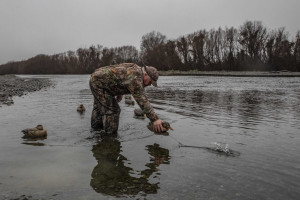
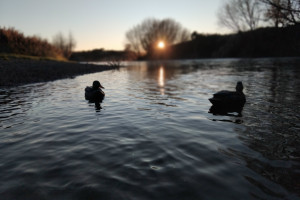
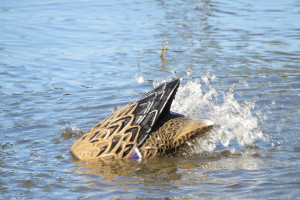

Decoy layout
A lot of hunters think that you can just throw some decoys out within range, and expect the ducks to come right on in. While this may work in some situations, duck hunting can usually be a lot more effective if some time is taken to consider a suitable spread. While there is any number of possibilities, the ‘J Hook’ and ‘Classic U’ are both basic and versatile spreads which many hunters use effectively on all types of waterfowl on big water, ponds and in the field. See the link to the resource below for further details on the ‘J Hook’ and ‘Classic U’ spreads.
There are also a few important factors to consider before setting decoys.
- Decoy Numbers —
The number of decoys you will require is situation dependant. For example, on a small pond, half a dozen decoys may be adequate. However, if you are competing for birds on big water, it is often a case of more is better. In many public hunting situations for opening weekend, four dozen decoys would be a minimum. When hunting pressure decreases after the first week or so, one or two dozen decoys will often be sufficient to create an effective spread
- Wind — Ducks always like to land into the wind, so for the best shooting opportunities try to get the breeze from either side or behind.
- Landing Zone — It is very important to create an open landing zone. It should be completely accessible so ducks don’t have to fly over any decoys to get to it.
- Motion Decoys — Typically ducks that are committed to decoys will key in on motion decoys. For this reason motion decoys should be placed well within shotgun range in the landing zone. If motion decoys are placed on the upwind edge of the landing zone, it will encourage ducks to sweep all the way across the zone, maximizing shooting opportunity.
- Be Flexible — Things don’t always go according to plan. If ducks are not coming into your landing zone, be prepared to change things around based on how they are approaching your spread. Sometimes it only takes relocating a few decoys to get the birds to commit.
Static decoys
Static decoys are the most common type used by duck hunters because they are cost-effective and easy to transport to hunting locations. They can be broadly categorised into two types: floating and field decoys.
Floating Decoys
These are the decoy type most hunters are familiar with. Made of plastic, they float on the water and are secured in place using a string and weight. They come in a range of styles depicting ducks in different behaviours such as swimming, loafing, or feeding. Floating decoys are available in a wide range of quality and price points, from basic and less realistic models to high-end options with detailed moulding and even flocked coatings (a special finish that reduces shine and adds realism).
Field Decoys
These are designed to be placed on the edges of water bodies (often alongside floating decoys) or in dry fields like pasture or stubble paddocks. Like floating decoys, field decoys come in various postures, levels of realism, and price ranges. Many models are also available with flocked finishes to improve realism and reduce glare. Standing decoys are very useful for expanding your hunting beyond hunting over water.
Silhouettes
This style of decoy is two dimensional, and usually simply pushed into the ground on pond edges and paddocks. Often home made from thin ply or corflute and then painted in matte appropriate colours. These decoys “fill out’ spreads and are a stable decoy for paradise shelduck hunting. Light weight and easy to transport, a good cheap addition to your waterfowl hunting gear.
Motion Decoys
Motion decoys are a great way to add realism to your decoy spread, helping to attract ducks by mimicking natural movement. There are many different options available, and in most cases, they are battery powered. However, manual options are also commonly used.
Spinning-wing decoys: These are often mounted on poles and are especially effective early in the season on younger, less wary birds. They’re usually powered by a 12V battery and can be set up on the shoreline or in the water.
Swimming, spraying or bubbling decoys: These come in various designs. For example, there are clip-on motors for standard floating decoys and those with built-in batteries and internal pumps to spray water. These are ideal for creating movement on still days and can be effective throughout the season.
Manual jerk cords: These simple setups involve one or more decoys attached to ropes and bungee cords. When ducks are observed in the vicinity of your hunting location, you pull the cord which causes the decoys to move, creating movement in the spread and ripples on the water. This is an inexpensive and effective way to bring life to your decoy spread.
Having movement in your decoy spread is crucial on still days. It can, and is, often the difference between getting ducks to come into range or bypassing your hunting position at altitude!
Decoy Maintenance and Transport
Your decoys will perform best and last for many years if you look after them properly. A few simple steps can help keep them in good condition season after season.
Keep these tips in mid:
Store decoys out of the sun - Avoid leaving decoys out on the pond between hunts (or between seasons), as prolonged sun exposure can bleach colours and degrade the plastic the decoys are constructed of.
Use a decoy bag - Transport your decoys in a purpose built decoy bag, especially if they are constructed of materials prone to scratching. This helps protect the paint from unnecessary damage.
Touch up the paint - Old, scratched and faded decoys can be brought back to life with a simple paint job. Use a basic matte brown spray paint for a quick and effective paint job. Avoid gloss paint, as it can create unnatural shine and reflect light, which may spook ducks.
Handle flocked decoys with care - These have a special coating that can wear off easily. Avoid rubbing or stacking them roughly.
Protect motion decoys from corrosion - If you're hunting near saline areas, such as coastal lagoons, estuaries, or tidal rivers, rinse any metal decoy stands with fresh water after each use and dry thoroughly. To prevent salt corrosion on electronics a spray with CRC/WD-40 can be worthwhile.