Newsletter December 2025
- 12/01/2026
Update From Chief Executive Corina Jordan
Welcome to this month's Fish & Game update. I hope you are getting out on the water.
You may have seen the Government recently announced Resource Management changes. These represent a significant change to natural resource management in New Zealand and will change how Fish & Game works in this space.
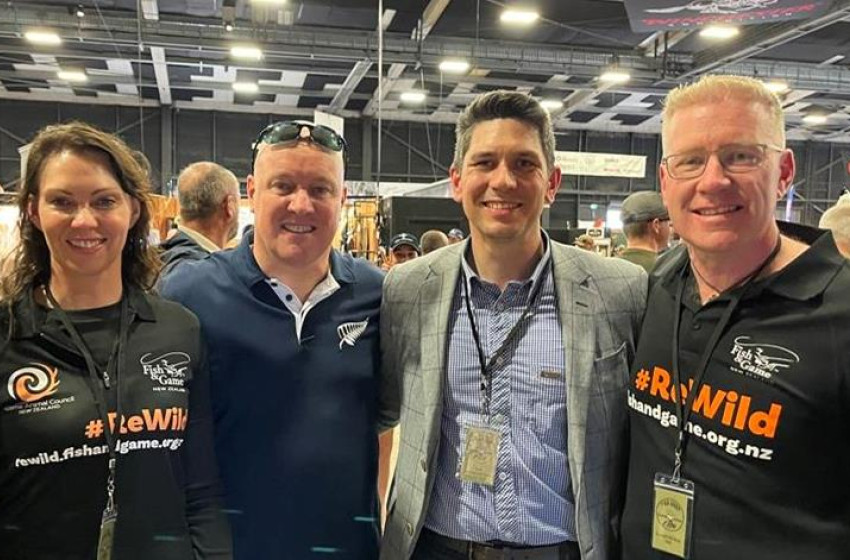
Pictured above: Corina with Prime Minister Christopher Luxon, Minister for Hunting and Fishing James Meager and Richie Cosgrove at the Sika Show in Hamilton.
There are a number of positive outcomes in the reforms as well as areas we want to take a closer look at. We will be talking to you, our licence holders, our stakeholders and Ministers about ensuring that the values and interests of anglers and hunters are recognised.
There are two wins in the reforms that we advocated for. Water Conservation Orders are staying and new ones can be created. That's great news. We also secured changes to make it easier for wetlands to be created or enhanced, removing the often time consuming and costly consent processes.
Two areas of concern are access and environmental limits, which provide for our salmonid fisheries. Read the item below for more details.
The new Arms Bill has also just landed. A link to Minister Nicole McKee’s media release including a link to the bill is available here. We are working through the details of the bill and will be sharing our analysis and advice with you in the New Year. There will be a six-month consultation period.
And of course, Minister for Hunting and Fishing James Meager is reforming Fish & Game and expects to introduce the Bill in 2026. We are working on background information, so we are prepared for when the bill goes to the select committee for consideration.
Our focus remains on ensuring that final legislation supports Fish & Game as a strong, modern and professional statutory organisation, ensuring the sustainable management of our sports fish and game birds and meeting the aspirations of our anglers and hunters. These reforms streamline processes and work where it makes sense but retain local region expertise for managing fisheries and game birds in their areas.
These developments are significant and weighty and do take up a good deal of my time. However, I love to get out and about to connect with our community which re-energising me for when I get back to my desk.
One of these moments was attending the Sika Show in Hamilton last month which showed a united sector in strong heart, looking to the future.
Last month, we hosted our second Parliamentary Fishing Trip, welcoming MPs and their families to St Arnaud for a weekend of fishing, conservation activities and connection with nature.
Building on last year's success at Lake Hawea, this year's Nelson-Marlborough event brought together parliamentarians from across the political spectrum. Guests experienced river, lake and boat fishing tailored to varying skill levels, followed by a communal dinner featuring their catch of the day.
The weekend concluded with planting kowhai trees at the Waimea Park Educational Fishery, giving MPs hands-on involvement in habitat restoration.
The Nelson-Marlborough team, National Office and other regions' staff, local guides and special guests including Dame Lynda Topp ensured expert support throughout. Feedback has been overwhelmingly positive, demonstrating Fish & Game's ability to build understanding of our organisation's value to New Zealand.
And lastly it was a pleasure to be at the opening of Otago Fish & Game Council's new office in Mosgiel. There's an item in this newsletter.
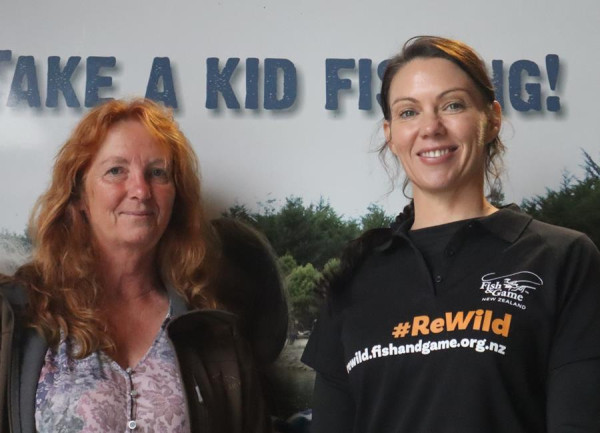
Otago councillor Vicky May with Corina Jordan
Resource management changes
Resource Management reform: what it means for you
The Government is replacing the Resource Management Act with two new bills: a Planning Bill to enable development and regulate land use, and a Natural Environment Bill to protect nature and encourage efficient use of land and resources.
What's changing?
The Government will replace the Resource Management Act with:
- Planning Bill - to enable development and regulate land use. See this site for more information.
- Natural Environment Bill - to protect nature and encourage efficient use of land and resources. See this site for more information.
The good news
Water Conservation Orders retained The 16 Water Conservation Orders protecting nationally significant water bodies will continue and more can be created.
Easier to create wetlands Proposed national standards could streamline wetland construction, potentially allowing creation without resource consent. This will benefit game bird habitat. This is something Fish & Game has been advocating for years.
Clearer, simpler planning system Reducing red tape and bureaucracy. Moving from over 100 plans to 17 combined plans will be more efficient.
Our concerns
While we welcome these positives, Fish & Game has concerns about some parts of the reforms:
Your values and interests The Resource Management Act specifically required consideration of trout and salmon habitat, amenity values and recreational opportunities. These provisions appear to have been removed or diluted.
Access to waterways The RMA required councils to maintain and enhance public access. The Planning Bill only requires councils to maintain access, removing the obligation to improve it.
Environmental safeguards While an environmental limits framework is retained, we'll be watching closely to ensure it provides robust protections for our fisheries.
What Fish & Game is doing
We'll be working hard to ensure your values and interests are recognised as this legislation progresses through Parliament. Our advocacy will focus on three key areas:
- Recognition of hunters' and anglers' values - ensuring the legislation properly considers trout and salmon habitat, game bird habitat, amenity values and recreational opportunities
- Access to waterways - strengthening provisions to maintain and enhance public access to lakes, rivers and the coast
- Habitat protections - securing robust environmental safeguards for the freshwater habitats our species rely on
We need your help
Your voice matters in this process. We'll be working with you on advocacy efforts as the bills progress through Parliament. Look out for updates on how you can contribute.
Our vision is a New Zealand where freshwater habitats and species flourish, hunting and fishing traditions thrive, and all Kiwis enjoy access to sustainable wild fish and game resources. We'll be working to ensure these reforms support that vision - and we need your support to make it happen.
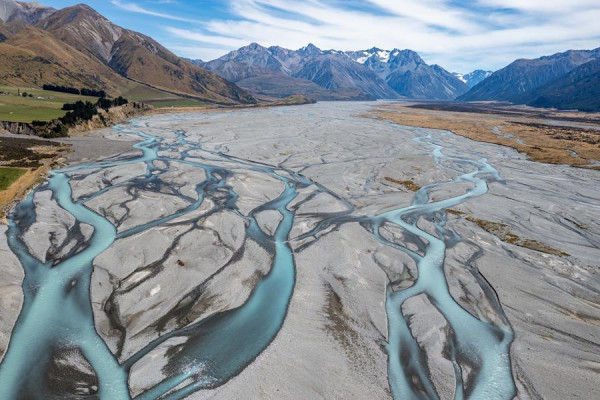
Great news: Water Conservation Orders protected in reforms
Fish & Game is glad that Water Conservation Orders (WCOs) will be retained in the Government's new Natural Environment Bill.
This is excellent news for anglers, hunters and all New Zealanders who value our most outstanding waterways.
The National Parks of our waterways
Water Conservation Orders are the highest level of protection for New Zealand's water bodies. Only 16 waters have this protection – including the Rakaia River, Ahuriri River, Mataura River, and Te Waihora/Lake Ellesmere. Fish & Game established 12 of these 16 orders.
The retention of WCOs shows the Government recognises the importance of protecting our most outstanding water bodies. Fish & Game highlighted the value of these protections throughout the development of the reforms, emphasising their importance given ongoing pressures on freshwater.
These orders provide enduring protection that ensures outstanding fishing and hunting waters remain protected for future generations.
Rewild
November ReWild update
Since the ReWild campaign launched on November 7th 2023, we’ve served 15,448,545 impressions across all media channels (Stuff, NZ Herald, Facebook, Instagram and YouTube).
We have reached 1,282,803 unique people on average 7.9 times each, with over 191,117 engagements across our media channels (reactions/likes, comments, shares, clicks, views, 3 second video views, competition entries), we have been flooded with support from Kiwis who share our love of wild places and now back our work.
Facebook/Instagram November 2025 overview:
During November we served 258,985 impressions and reached 140,474 unique people. We had 1,207 content interactions, including reactions/likes, comments, shares, saves and link clicks. Additionally, we gained 139 new followers on Facebook and 42 new followers on Instagram.
Helping Your Have a Successful Season
If you want to sharpen up your skills and learn something to improve your chances of success, there are some great resources available on our website.
Check out this page for tools to help make the new season a success!
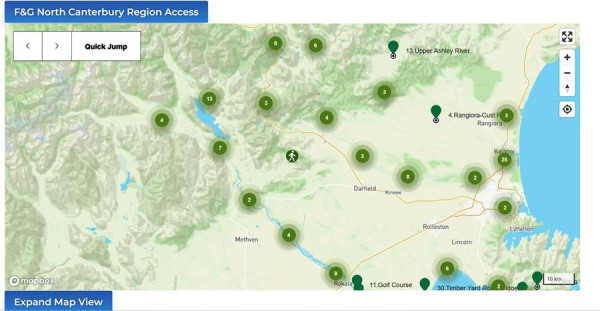
Also, don't forget we have a great mapping resource on our website to help you find access points.
Go here then click on the down arrow where it says access points.
Environment Court protects Hawke's Bay waterways
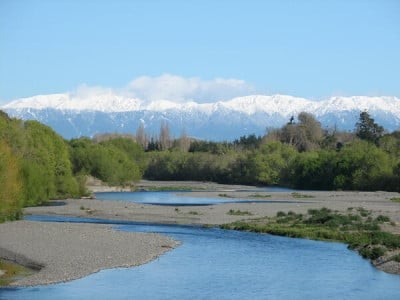
Hawke's Bay Fish and Game, alongside the New Zealand Council, Forest and Bird, and Tamatea, has successfully defended against an appeal for significant water extraction in the Hawke's Bay region which we were concerned would significantly reduce flows on the Tukituki River and its tributaries. The Tukituki is among one of the top North Island fisheries.
Background
In February 2023, commissioners acting for Hawke's Bay Regional Council declined an application from a group of eight parties seeking to take 15 million cubic metres of water (known as Tranche 2 allocation) for irrigation and stream augmentation purposes.
Two of the original applicants appealed this decision to the Environment Court, reducing their request to 3.88 million cubic metres. Fish and Game participated as a section 274 party, meaning we joined the case to support the council's original decision.
The Decision
On 14 October, the Environment Court released its decision, declining the applications and refusing the appeal - a successful outcome for Fish & Game and the other parties involved.
Key Findings
The Court's decision reinforced several important principles for water management. The judges found that the applicants failed to demonstrate sufficient burden of proof and lacked an integrated approach to water management. Critically, the Court determined that the ecological evidence presented was either lacking or inadequate.
The decision also confirmed that considering only incremental effects does not properly account for cumulative impacts on waterways. The Court noted deficiencies in the modelling and related evidence and found that the applicants had not attempted to assess their proposal against the natural state of the affected water bodies.
Perhaps most significantly, the Court stated: "we do not agree that the evidence demonstrates that the Proposal achieves that part of the Objectives that relates to sustaining aquatic ecosystems."
Case reference: Decision 2025 NZ EnvC 328; (ENV-2023-AKL-057) I&P Farming Ltd and Te Awahōhonu Forest Trust v Hawke's Bay Regional Council
Otago Fish & Game Council have officially opened their new headquarters in Mosgiel
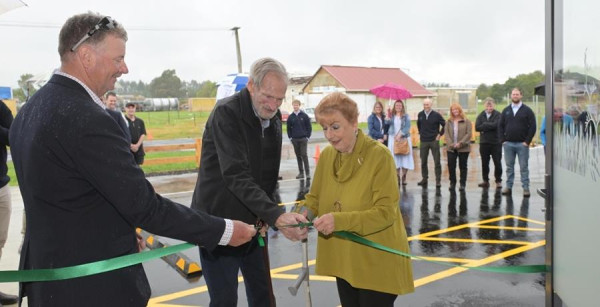
Cutting the ribbon at the new building in Mosgiel on December 3 are Otago Fish & Game Council chair Adrian McIntyre (left), past chair Dr John Jillett, and Colleen Wright, the wife of the late former chair Monty Wright. Photo: Gerard O’Brien, Otago Daily Times
by Bruce Quirey
This month Otago celebrated a big milestone for the regional organisation - a new purpose-built home on Hazlett Rd, blessed in a whakawatea led by a representative from Ōtākou Rūnaka and opened in a ceremony alongside Otago councillors, staff, partners and supporters.
The new base brings everything under one roof and puts regional staff closer to the rivers, lakes and wetlands where the work happens. With solar panels, EV-ready infrastructure and modern facilities, it’s built for the future — and for the anglers and game bird hunters who fund our work.
The project was funded through the sale of Otago Fish & Game Council’s previous Dunedin property, allowing the upgrade with minimal impact on their reserves.
The opening ceremony was dedicated to the memory of long-time Otago staff member and chair the late Monty Wright. The ribbon was cut by Monty's wife Colleen and former chair Dr John Jillett with present chair Adrian McIntyre.
Women On The Fly Update
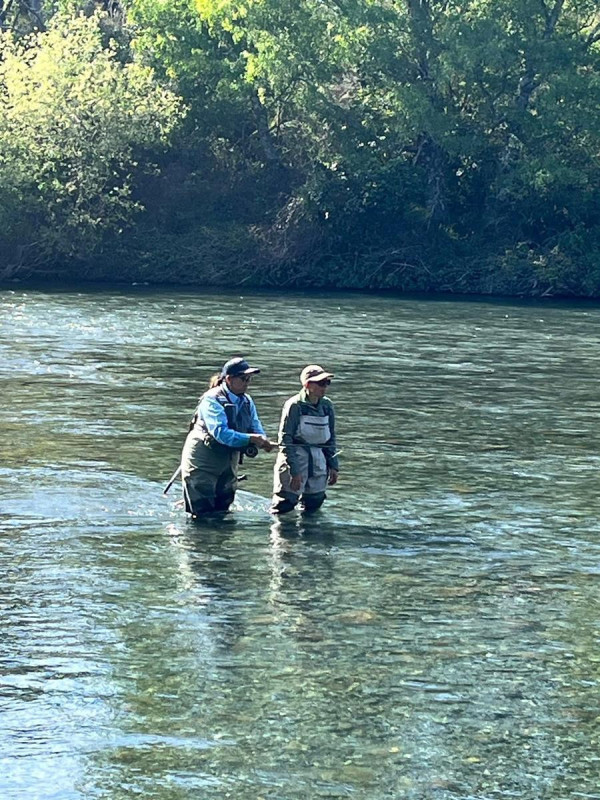
by Leigh Johnson
Women on the Fly NZ 2025 – A Weekend of Learning, Connection and First Catches in Turangi
The 2025 Women on the Fly NZ weekend workshop was a standout success, hosted in Turangi and supported by Fish & Game New Zealand.
Over the weekend, 40 women anglers took part - with 22 brand new to fly fishing - making it one of the largest and most inclusive events of its kind.
Participants were guided through every aspect of the fly-fishing craft: rods, lines, rigs, casting, basic fly tying, entomology, reading the water, and fishing methods including traditional indicator setups, Euro/Czech nymphing, and wet lining.
The learning didn’t stop at the casting lawn. Each angler rigged up their own rod and headed out to the Tongariro River, where mentors provided hands-on guidance. Many landed fish - for some, their first-ever trout, and for others, their first on a new method learned during the workshop.
“The best part was watching the smiles as women hooked their first fish - and realising they were now part of something bigger: a welcoming, supportive angling community.” - Women on the Fly NZ Mentor, Ivy Morrison
Beyond the fishing, the weekend celebrated community and connection. Friendships were made, confidence grew, and future fishing trips were already being planned.
Fish & Game support initiatives like Women on the Fly NZ, which help grow participation in the sport and foster stewardship of New Zealand’s freshwater fisheries.
Learn more or get involved at womenonthefly.nz
Biosecurity update
Gold Clam (Corbicula fluminea) was discovered at Lake Rotomanu during Taranaki Fish and Game’s Take a Kid Fishing Event, held on Saturday 8 November. This is the first confirmed detection of this highly invasive species outside the Waikato.
Lake Rotomanu is in New Plymouth and is a heavily used, easily accessible spot for boating and recreation. The lake is currently closed to boats while a technical working group is being established to explore the most efficient means of clam eradication.
Taranaki Regional Council has announced the lake will be drained, a process that will take four days starting today.
During this time the fish population will be harvested, and Wellington-Taranaki Fish & Game are seeking access to the trout for licence holders.
A team from Earth Sciences NZ will next week carry out a detailed survey of the whole lakebed to determine where and how widespread the clams are, how deep they have burrowed and estimate the age of the clams present.
That information will help inform the next steps in the response. In particular, whether an elimination attempt is feasible and if so, what the treatment options are and how much they would cost.
Check, Clean, Dry
Protect Our Waterways: How you can help to stop invasive pests
New Zealand's pristine rivers and lakes face a serious threat from invasive freshwater pests like didymo and the invasive freshwater clams. These destructive organisms can spread with frightening ease – a single drop of water is all it takes to contaminate a new waterway.
The good news? Anglers can play a vital role in protecting our waters by following three simple steps between visits to different waterways:
CHECK Before leaving any river or lake:
South Island recreational freshwater users: Stick to the tried-and-true, pre-clam Check Clean Dry method!
- CHECK: Remove all plant and other material from items that have been in the water
- CLEAN: Mix 10% dishwashing detergent with water, use to soak or scrub all items and leave wet for 10 minutes.
- DRY: Dry items completely and leave for at least 48 hours.
North Island recreational freshwater users: Follow the clam-inclusive Check Clean Dry protocol that will kill the clam as well as other invasives.
- CHECK: Remove anything visible like mud, weed or clams from watercraft and gear. Drain all river or lake water.
- CLEAN: Wash down your gear (including boots) and craft with tap water, not into a stormwater system.
Use a cleaning treatment for absorbent materials:- Soak in hot water (55◦C) for at least 5 minutes OR
- Soak in 5% household bleach for an hour OR
- Freeze solid overnight.
- DRY: Dry any areas where water has pooled. Then dry watercraft and gear to touch, inside and out and leave to dry for 2 days.
Remember: If you prefer not to treat your gear, simply dedicate it to a single waterway. This option eliminates any risk of cross-contamination while still allowing you to enjoy fishing.
By following these guidelines, you're helping preserve our waterways for future generations of hunters and anglers. Every precaution counts when it comes to protecting New Zealand's precious freshwater ecosystems.
Disclaimer:
The information presented in these news items is based on the context and regulations in place at the time of publication. Please note that some articles may include reference to laws and regulatory standards that have since changed. For the most current and accurate information please check our Fishing Licences & Regulations pages or our Hunting Licences & Regulations pages.