Backcountry on a budget
- 10/10/2025
Article by : Nick King
As in life itself, angling is a journey from introduction to retirement, from the fizz of the first fish hooked to the nostalgic, fulfilling, somewhat sombre passing on of equipment to the next generation.
How and where we choose to fish also ebbs and flows as we travel this journey, as does how we are able to or choose to access waters that fascinate us, feeding the wanderlust within.
In any anglers life, talk of distant and legendary trout waters, flowing in the hinterland of our wild native places can call like a siren, pulling at one with the intensity of young love, demanding of us to go and explore, to experience and perhaps walk in the footsteps of and attempt to measure up to the long past paragons of our angling lore, or just for the sheer delight of the time, the place, the company and the fish.
|
|
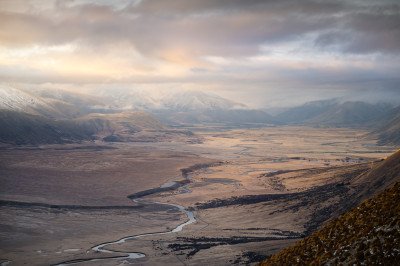
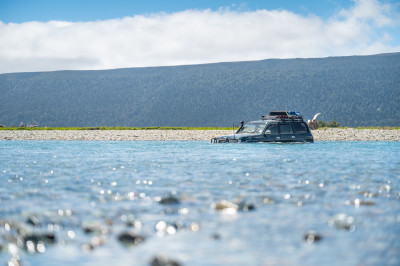
| In any anglers' life, talk of distant and legengary trout waters, flowing in the hinterland of our wild native places can call like a siren | When young we might not be able to finance splendid means of transportation but that shouldn't limit us |
These fabled destinations are at the very apex of our recreation, yet they do not need to be kept from us by our inability to finance splendid mechanical creations like the jet boat, the four-wheel-drive or of course the ‘grand poobah’ of backcountry travel, the mighty helicopter.
All stages of life bless us with strengths and weaknesses, attributes and liabilities, opportunities and restrictions and as anglers we just need to muster the gumption to accept our lot at the present and use our available assets to get into the action.
The young tyro, perhaps recently released from formal education, may be desperately compromised in the finance department. Yet that young, fit, strong body and freshly minted enthusiasm is every bit the equal of a more senior angler’s ability to fund and utilise alternative methods of backcountry transport.
The other superpower of youth is time. Time to journey and explore, time to get to and return from far off spots, time that is not tempered by responsibility or compromise and time to enjoy without the encumbrances of age. With that being said, let’s look at a basic walk through on backcountry fishing for those on a budget and what compromises backcountry in practice as well as in mind.
With turbine helicopters running close to the tune of about a dollar a second, the ubiquitous Shanks’ pony really is the answer to getting to amazing places on the cheap. It’s about 60 times as slow (helicopters can cover up to 4km a minute vs walking’s 4km an hour) but it’s free other than the boot leather. Side benefits include the journey itself, often through spectacular scenery.
It should also not be forgotten that many wilderness rivers actually wend their way into the front country and can be accessed straight from the road. There very well may be two or more days angling before you hit the preferred fly-in zone. It’s the same river, and you may just find a kilometre or two that is being completely overlooked. Somewhere that’s too far for a day angler but too close to fly to. Overlooked water attracts fish as they enjoy free feeding, devoid from our attempts at gourmet trickery. It may even hold a trophy or two that have slipped down to a more restful spot.
The second thing to consider when looking at piecing together a bit of a scruff about far from the madding crowd is the legal status of the rivers you are interested in... especially pertaining to air access. There are a significant number of rivers of exceptional quality that do not have air access, such as wilderness areas and National Parks with no air access strategies. This is where the young and fit have a real advantage over the well healed but higher mileage angler. No helicopters mean very few guides and clients and many less senior anglers, as they no longer wish to put in the sweat equity to get there and back. All this information is at your fingertips with a Google search.
If air access is an available option in the area you wish to explore, then it may pay to look at going early or late in the angling season as the vast majority of guided, overseas and Kiwi helicopter access anglers will look at mid-November to mid-February to complete trips. This along with opening week can be a busy time and encounters with other parties will naturally increase.
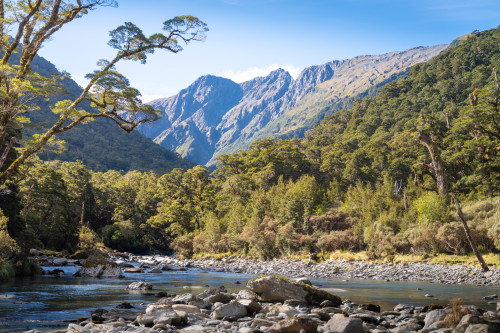
There are a significant number of rivers of exceptional quality that do not have air access, such as wilderness areas and National parks with no air access strategies.
If you are looking at walking a long way in to the wopwops for Opening day it may seriously pay to be where you want to be one full day ahead of opening to avoid that sinking feeling as a helicopter goes over to the hut when you’re on the last hour of your day long tramp. You can use the spare day to hunt or just watch the fish. You learn a lot from watching, and the excitement of waiting for opening dawn ratchets up a few notches as well.
If one is planning on walking great distances across rugged terrain to get to secluded locations, keeping gear to a minimum and angling equipment to the essentials is necessary. When packing, put things into three piles. Essentials, nice-to-haves, and luxuries. As you get fitter and stronger, then more nice-to-haves and some luxuries can sneak in. If you want light and flexible, stick to the essentials. If you’ve got a partner or two in crime it is good to specialise rather than everyone bringing everything. That does not go for rods. Make sure there’s a good supply of rods. You can usually get two into one rod case which is good insurance in times of breakage. If you’ve ever got down to one remaining rod on a wilderness mission, that rod becomes a deity. I’ve been there on occasion and it’s stressful.
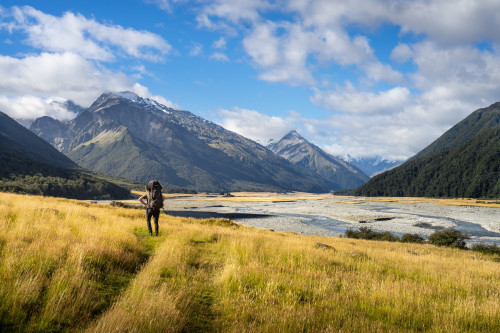
If one is planning on walking great distances across rugged terrain to get to secluded locations, keeping gear to a minimum and angling equipment to the essentials is necessary.
Look at using a fly-fishing lanyard over a vest. That and a couple of waterproof fly-boxes and you’re racing. Things like landing nets, tents, cooking equipment, battery-banks, and camp saws, even down to a Leatherman can be divvied up among the group.
One super handy but admittedly expensive leveller in the access department is the pack-raft. It enables deep sections of river to be crossed and – with a bit of practice – ferrying gear and people across calm stretches becomes second nature. One quality pack-raft can easily float two chunky monkeys for a crossing and gives access to water that may get very little attention. If each member has a pack-raft they also become a great way to return to the car at trip’s end.
Internal storage in the tubes can minimise the bulk on the raft and make for a real highlight utilising gravity and flow for a foot saving and comparably quick exit from the wild.
Obviously, the main focus of backcountry wilderness fishing is in National Parks, Forest Parks and Stewardship land within the DOC-administered estate. This is due to the excellence of the experience far from roads and cell service, as well as the guaranteed right of unhindered and uncomplicated public access, and the track and hut network that can be factored into wilderness river adventures. The fishing on any given day can range from off the charts to plain tough just as any angling can, yet the experience can’t be replicated in the inhabited areas of our nation... or can it?
Are we perhaps a bit snobbish about what we include as backcountry angling? And if so, where can we replicate (to a degree) these experiences in areas within earshot of traffic and such, just by thinking about if differently?
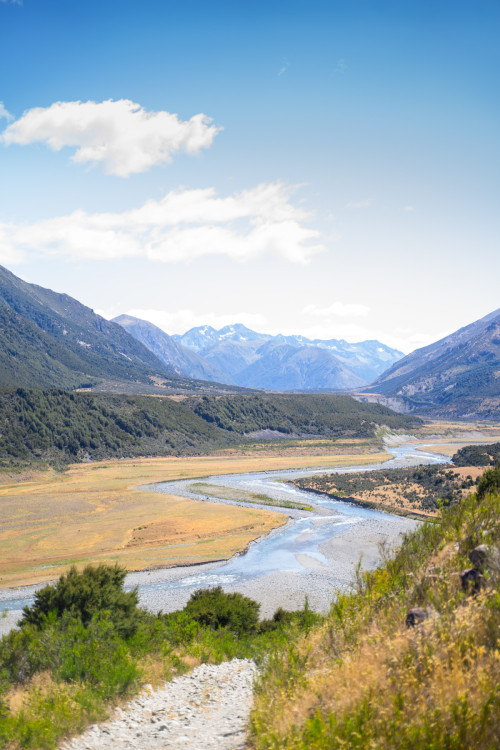
It should also not be forgotten that many wilderness rivers actually wend their way into the front country and can be accessed straight from the road.
Many of our braided rivers, as well as lower sections of other rivers, have long public land sections that are very underutilised by the angling fraternity. Once out in these riverbeds it feels very different than looking from the road. Life goes on around you, but you are removed to a surprising degree and once you focus on the water you’re in your own world. It’s possible to string together a few days, camping in the riverbed or along the edge, and again find water and an experience than can go a long way to approximating a more isolated destination.
Dave and I stood at the car and looked at the mountains climbing skyward before us. Somewhere behind those peaks, still resplendent in a salt and pepper dusting of snow, flowed a river of dreams with a fantasy name and fabled by those in the know to be 70 per cent trout and 30 per cent water. This was to be our destination for the opening day of the season, and we had planned to arrive on opening eve.
Ahead lay a big climb, a tops traverse then a long untracked and fractured bush ridge descent to where the river met its siblings at a great three-way confluence. At that confluence sat a small, rarely visited hut that was almost as revered as the river it overlooked.
In our early twenties we were perpetually broke as we were both in the infancy of our careers and any expendable income was put into equipment needed to explore. The getting there was upon us and having gone full throttle in the hunting department over the last couple of years, we were physically at the top of our game.
As we warmed to the climb, the sky lost its blues and became ashen and sullen. We made the tops in good time and began an extended sidle along an easy spur. The temperature dropped, as did the cloud base, until we were enveloped in drenching heavy mist and the visibility plummeted to metres.
Much plotting of coordinates into a first generation GPS kept us moving and eventually we were on the bush edge that matched up with the soggy Topo map we held. As we began our decent the brewing storm broke with accompanying knife, fork and spoon lightning.
The September 30 dark descended upon us with many kilometres to go and in atrocious conditions we were confronted by a dead end on a wrong-turn side spur that terminated in a hundred-metre cliff. Setting up our bivis we reconciled that we would make it there on opening day instead. Just as I discovered that our landing net had been plucked out of my pack by the forest, Dave kicked his pack… which fell over the cliff into the inky black. Things were evolving into a real goat-rope.
After a long and cacophonous night in pelting rain we made it through to a monochrome dawn and went about rectifying the previous night’s disasters. Looking over the cliff we discovered Dave’s pack was three feet down, hanging from an Olearia bush by a compression strap. We retrieved it with some heart-in-mouth youthful lunacy and then discovered the net was only 50 metres back in a tree.
We arrived bedraggled at the hut to the sight of a swollen river and the conspicuous whiff of burnt kerosene emanating from the flattened grass.
As we rounded the corner, there, sitting pride of place on the porch were two pairs of wading boots, two strung up rods, a large chilly bin and a fishy smelling landing net. As the heavens opened again, two smiling faces appeared in the doors window. We were still in shock when a voice said: “You two look like you could do with a cuppa.” The door opened and we were hit in the face by the smell of bacon and coffee and the rush of warmth from an idle fire.
If this anecdote serves as anything more than an idle musing, it is perhaps this:
There are more ways than one to arrive at the same destination. Neither holds moral superiority over the other; the party that expended time and energy taking the physical path is equally matched by the party that worked just as hard over time in order to pay to take the express path and accompanying luxuries. It’s what happens next that is the most important.
For us, that was the genesis of a lifelong friendship – four guys in different stages of life taking different paths to arrive at the same place for the same reason. That relationship still stands and 30 years on we will again share an opening day together in October as we have each year for the 29 years in between.
Ps. The fishing coming off a spate was epic...
Disclaimer:
The information presented in these news items is based on the context and regulations in place at the time of publication. Please note that some articles may include reference to laws and regulatory standards that have since changed. For the most current and accurate information please check our Fishing Licences & Regulations pages or our Hunting Licences & Regulations pages.