Reel Life January 2026 - Otago
- Otago
- 20/01/2026
Welcome to the Otago edition of Reel Life for January.
Please note: Otago Reel Life is a compilation of highlights from recent Otago Weekly Fishing Reports. Read below for how to sign up for your weekly fishing news.
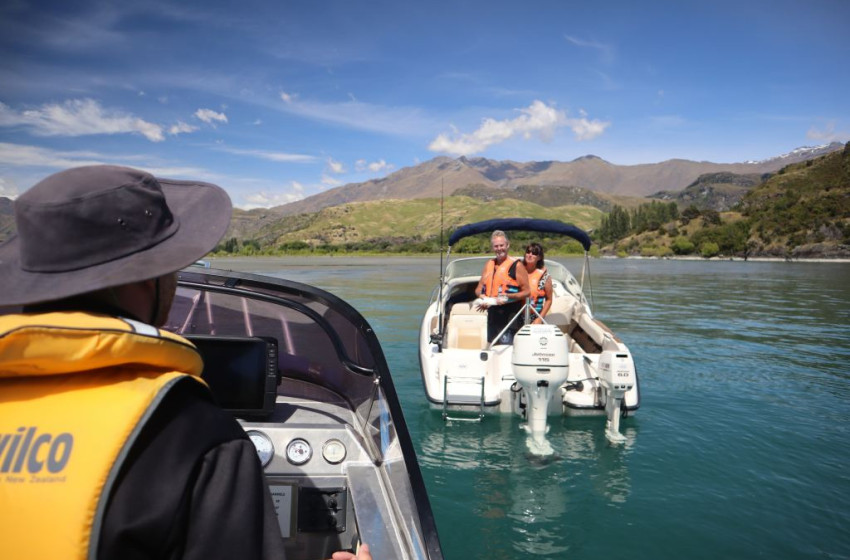
Image above: Otago Fish & Game officer Cole Briggs chats to Shane and Cassandra Alexandre with a brown trout caught trolling in Lake Wānaka over the Christmas-New Year holidays. Photo: Bruce Quirey
Otago Weekly Fishing Report
The Otago Weekly Fishing Report is published free weekly on Thursdays during the main fishing season.
- If you haven’t subscribed, you can click here.
- The weekly report will be emailed to your inbox with up-to-date fishing conditions, weather and river flow information to help improve your catch.
- You’ll also get a behind-the-scenes look at the work Otago Fish & Game does for our licence holders.
- You can catch up on previous regional reports on the Fish & Game website: Regional Fishing Reports - Tagged with Otago
Here’s a taste of what you may have missed in our recent weekly fishing reports:

Trolling on Lake Wakatipu near Glenorchy last weekend are Aurel Bordewieck (centre), Arnold (5) and Penelope (3) with Aurel’s sister Louisa (left) and Markus at the helm. Photo: Bruce Quirey
Fish & Game rangers and volunteers have been active across the Central lakes and popular rivers this summer, keeping a strong presence both on water and on land. Recent checks recorded excellent compliance, with most anglers carrying their plastic licence card — or providing ID and a receipt when needed — making inspections quick and easy, even on windy afternoons. Anglers reported challenging fishing conditions, with discoloured water reducing bites; dark-coloured lures such as black patterns often work best in these conditions.
A timely reminder when fishing lead line: keep steady pressure on the fish. Rangers watched an unlucky angler lose a solid rainbow at the boat after slack line allowed it to duck under the hull and jump on the far side — working the hook free.
Overall summer compliance remains high at above 95%, though fishing without a licence and using multiple rods continue to be the most common offences. With staff and volunteers ranging widely, you never know when you might be checked — so please carry your licence at all times. Based on trends observed this season, remember:
Compliance reminders:
- Always carry your licence. This makes checks quick and easy for everyone.
- No licence and no form of identification will result in gear being seized.
- Look after yourself, your family and your mates by checking that everyone fishing has a valid licence. We have encountered several new anglers encouraged to “have a go” by friends or family without holding a licence, which has resulted in offence notices and borrowed gear being seized. A day licence is quick and easy to obtain.
- Make sure junior anglers have their licence. We have seen many keen young anglers out over summer, not all of whom were licensed, often because parents assumed it had been organised as in previous years.
- Check you have your licence before heading out. If you don’t have a card, receipt, or paper licence, you don’t have a licence.
Refining your technique

Paul Donoghue (right) and his son Thomas (7) trolling with Martin at the helm in Stevensons Arm on Lake Wānaka over the summer holidays. Boat fishing. Photo: Bruce Quirey
Most boat anglers we’ve encountered on the lakes over the past couple of weeks were having some success on rainbow and brown trout and landlocked salmon. However, others might have more luck with simple adjustments to their technique.
- Be careful not to troll too quickly — about walking pace is often ideal, although it can vary. Slowing the pace will allow the lure to reach correct depth and will appear more natural to predators.
- Check your trolling depth — trout are often within only 1-2 metres of the bottom.
- Use your depth sounder to follow the lake contour where fish feed in the littoral zone; at river mouths; along drop-offs; and off points.
Youth trust outing lands new personal best

Octavier Neal (aged 15) with his second-ever trout, a lovely 4lb brown, caught fishing from the shore on Lake Dunstan. Photo: Mason Court
Last week Otago Fish & Game staff helped the Cromwell Youth Trust for a few hours of fishing. The trust was also the first group this season to help us do native planting at Bendigo Wildlife Management Reserve back in spring. A keen group of 12 young anglers – ranging from complete novices to more experienced fishers – and four supervisors gathered at the edge of Lake Dunstan mid-morning on Wednesday.
After a casting demonstration and some tips from staff, the group headed out onto the water. Novice angler Eden landed the first fish, a 38cm perch on a black-and-gold Toby. The next catch was a 4lb brown trout, taken by Octavier on a traffic-light Toby. He had chosen a lighter lure with a single hook after his Tasmanian Devil, fitted with a treble hook, proved too heavy and kept getting caught in the weed along the lake edge. This was his second-ever trout and a new personal best.
The fish were iced for the table, and the group enjoyed a fantastic day, continuing to fish for several more hours in the afternoon.
Clutha salmon

Megan Findlay with a 13lb Clutha sea-run salmon caught on light trout soft-baiting gear on the lower Clutha River. Photo supplied.
Megan Findlay recently achieved what has unfortunately become a very rare occurrence, landing a salmon in the Clutha / Mata-Au River. Making the capture even more remarkable, the fish was fin-clipped and taken on light trout gear using a soft-bait.
Hatcheries clip the adipose fin, the small fleshy fin just in front of the tail on a salmon’s back, to help monitor the size and number of returning fish. As there is currently no recreational salmon hatchery operating on the Clutha / Mata-Au, this fish most likely originated from a hatchery on the lower Waitaki or lower Rangitata rivers. A commercial salmon hatchery at Inch Clutha which supplies salmon farms does not release salmon for recreational fishing.
If you are lucky enough to catch a salmon on the lower Clutha, we would love to hear from you. Please send through photos. Phone us on (03) 477 9076 or email otago@fishandgame.org.nz. If you retain the fish, keep the head in your freezer and contact us to arrange collection. A small bone at the base of the brain, known as the otolith, can be analysed to identify where the salmon was born, helping us better understand movements and protect those crucial habitats.
Knot sense
Fish & Game staff and rangers are often asked what the best knot is — whether it’s for tying on a lure, creating a loop for soft baits or flies, or joining braid to a leader.
There are many knots anglers can use, but the following are simple, reliable and widely used, making them a great starting point for most anglers.
Improved Albright Knot – Braid to Leader
The Improved Albright Knot is commonly used to join braided mainline to a mono or fluorocarbon leader. It is strong, compact, and passes smoothly through rod guides.
YouTube: https://www.youtube.com/watch?v=kbbYRAovo6o
Improved Clinch Knot – Hooks and Lures
The Improved Clinch Knot is one of the most common fishing knots. It is easy to tie and suitable for attaching hooks, lures, swivels, and flies.
YouTube: https://www.youtube.com/watch?v=2YO7JWNdVC0
Lefty’s Loop – Adding Movement
Lefty’s Loop creates a free-swinging loop that allows lures, spinners, soft baits, and flies to move more naturally in the water.
YouTube: https://www.youtube.com/watch?v=43ZO8n4J1HQ
Quick Tips
- Always wet knots before tightening. It reduces risk of knot damaging due to heat friction.
- Pull knots tight slowly and evenly.
- Always test your knots (when using braid be careful to use clothes or a towel to avoid the braid cutting you).
- Practise tying knots before heading out fishing. (The old saying “If you don’t know knots, tie lots” is true.)
Log watch
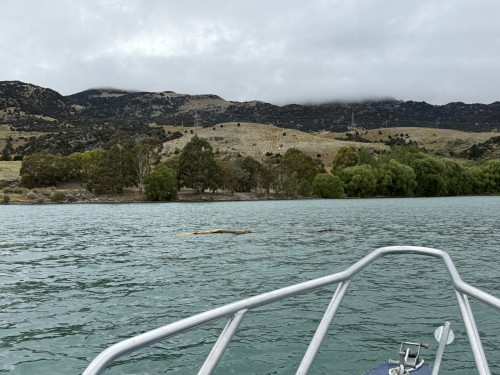
One of many large logs on Lake Dunstan during a creel survey on Thursday. Photo: Mason Court
With recent rainfall and more rain forecast, a lot of debris has built up in the lakes. Fish & Game rangers doing licence checks last week saw large numbers of branches and sizeable logs, particularly around the Dingle River mouth. Lake Dunstan is no exception, with multiple large logs sighted in the middle of the lake during a morning creel survey, posing a serious hazard to boaties. Combined with slightly discoloured water, this debris can be difficult to see and avoid. Anglers and boaties are urged to take extra care, as some logs are up to four metres long and could cause significant damage to boats.
Tanin stained tributaries

A beautifully coloured brown trout caught by Hadlee Edmunds from one of the tannin-stained lower Taieri tributaries. Photo: Supplied
Often overlooked, the tributaries of the lower Taieri can provide excellent fishing on their day. These include Deep Stream, Lee Stream, Sutton Stream, and Waipori River.
These rivers are typically harder to see into compared to the clear rivers of Central Otago, with tannin staining the water. Despite this, they offer superb fishing for both fly and spin anglers. Late January and February are especially popular as fish begin to focus on terrestrial prey, such as cicadas.
Dark-coloured soft baits and small spinners are effective for blind fishing in the darker pools and runs. Fly anglers often have success with gold bead pheasant tail flies in size 12 or olive woolly buggers.
To explore access points for the Taieri River and its tributaries, refer to the Otago Access Map: Click here
Tricking out your Tassie

Tasmanian Devil lure re-rigged with a small bead and single hook. Photo: Mason Court
Tasmanian Devil lures are a staple in the tackle boxes of many Otago anglers, whether trolling or spin fishing, and for plenty of people their first fish or favourite lure has been caught on the humble Tasmanian Devil.
One issue often raised by anglers new to fishing is a low hook-up-to-landing ratio when using these lures. This can be even more noticeable when trolling with a paravane or lead line. In many cases, the problem comes down to the small treble hook supplied with the lure, which doesn’t always result in a solid hook-set.
Many anglers find their success improves by swapping the treble hook for a larger single hook. The simplest way to do this is to run your leader through the lure, then through a small bead, and tie it directly to a single hook. This setup provides a stronger single point for hooking fish and allows the lure to slide freely on the line. When a fish jumps, the sliding lure gives it less leverage to throw the hook. The bead is important, as it keeps the hook free; without it, the hook can jam into the lure and negatively affect the swimming action.
For extra attraction, the single hook can also be replaced with an appropriately sized streamer-style fly.
Perch on the fly

Jayde Couper with a perch caught on fly in the lake shallows. Photo: Jayde Couper
Otago Fish & Game ecologist Jayde Couper recently landed his largest perch to date on a fly rod, made even more rewarding by sight-fishing to it in the shallows. As temperatures rise, perch fishing in Otago lakes is coming into its own, and careful observation can make a big difference.
One standout insight was just how shallow perch will push. Fish were seen travelling surprisingly long distances tight along bankside vegetation, highlighting the value of fishing hard along the edges rather than focusing solely on deeper water. In these areas, small, lightly weighted streamers fished on a floating line proved effective. The same approach suits spin anglers using a bubble set-up.
A small green Woolly Bugger produced consistent results, likely imitating either a small baitfish or a damsel fly nymph — both common food sources in weedy lakes.
Retrieve speed also mattered. Unlike trout, which can often be triggered by speeding up a retrieve, perch were consistently put off by this approach. Slowing the retrieve right down — sometimes almost to a stop — proved far more effective and usually resulted in a take.
Stealth was equally important. Perch feeding in shallow water were easily spooked by wave action from wading or clouds of silt kicked up underfoot, making slow, careful movement essential. Interestingly, the fish showed little concern about a fly landing nearby, and casting close to a visible swirl or tail often drew an immediate response. Sharp hooks were also critical, as perch have tough mouths and can be difficult to keep pinned.
As a bonus, a good eating trout was also landed, feeding aggressively on adult damsel flies but still willing to take a streamer.
From lake to plate

After a hot day on the water, it’s hard to beat a simple fish fry-up. This recipe comes via Selwyn Clarke, passed on from his son in the Navy, and it produces a light, crispy batter that stays crunchy well after cooking. Rice flour is the key, and while regular flour helps with browning, it can be left out for a gluten-free option.
Perch fillets are lightly salted, dusted in rice flour, then dipped in a batter made from equal parts rice and regular flour, a little baking powder, and ice-cold beer mixed to a thin consistency. Frying at around 175°C until lightly golden gives excellent results. Drained on a rack and finished with a pinch of salt, the perch was served with oven chips, lemon, and sauce of choice.
We cooked the perch alongside some blue cod from the freezer and, on the day, reckoned the perch was every bit as good, if not better.
New fishing access points open

Otago Fish & Game honorary ranger Dan Natta checks out one of the new access points on the upper Catlins River. Photo: Bruce Quirey, Otago Fish & Game
We’ve officially opened five new public fishing access points on the Catlins River. Located along Cairn Rd near Wisp Hill, these new spots make it easier to legally and safely reach this tea-coloured fishery.
Our recent ecological surveys showed a thriving, self-sustaining population of brown trout, as well as non-migratory galaxiids and kōura. However, a lack of formal access meant many anglers were accidentally trespassing.
This project was a great collaboration between Otago Fish & Game and Southern Forests Ltd. To make this possible:
- Fish & Game access signs have been installed on roadside gates to help you find your way.
- Southern Forests Ltd and the landowner invested tens of thousands of dollars in gorse and broom control near the river.
- Through the forestry company, almost 200,000 mixed natives have been planted to support the local environment.
A locally important fishery, Catlins River sustains thousands of angler days every year (2023 National Anglers Survey — NIWA). We’re thrilled to work with landowners who value recreation and environmental outcomes as much as we do.
Check out the new access points on the Fish & Game online access map:
https://fishandgamenzaccess.org/fg-otago-region-full.../
Please remember to treat the land and river with respect: leave only footprints.
To the Upper Manorburn

Father and son Leighton and Tom McRitchie fishing at Upper Manorburn Dam this month. Photo: Bruce Quirey
Upper Manorburn Dam is unusual among Otago’s high-country tussock lakes in that it has a self-sustaining rainbow trout fishery and no brown trout. This irrigation reservoir was fishing well on Monday under blue, calm skies.
- Spin anglers our Fish & Game rangers met had all caught fish. Father and son Leighton and Tom McRitchie from Clyde had caught five rainbow trout spin-fishing from shore when we met them mid-morning. They were using black-and-gold Tasmanian Devil lures.
- Boat anglers had success trolling lead lines with bright lures in about 2 metres depth.
- A fly angler we met was finding the trout a bit picky but they were rising frequently. On the water were brown manuka beetles, midges, crane flies and lady beetles. Look out for cicada hatches on hot days.
Don’t Forget Your Licence
Get your licence online or visit a local agent.
Click the link for a list of the agents in Otago where you can buy a licence.
Event Calendar
Click here for upcoming fishing events throughout New Zealand.
- Looking for places to fish? Check out this link: Where to Fish — Otago
- The ORC Environmental Data Portal is an excellent tool for monitoring flow levels.
- Before you head out, be sure to check this season’s regulations: Otago 2025-26 Sports Fishing Regulations.
Want more info? Check out these links or contact our helpful Otago team.
- Trout Fishing Made Easy
- Otago Fish & Game Facebook page
- Otago Fish & Game webpage
- Otago Fish & Game, 5 Hazlett Road, Mosgiel
- Tel: (03) 477 9076
- Email: otago@fishandgame.org.nz
Tight lines,
The team at Otago Fish & Game Council
Disclaimer:
The information presented in these news items is based on the context and regulations in place at the time of publication. Please note that some articles may include reference to laws and regulatory standards that have since changed. For the most current and accurate information please check our Fishing Licences & Regulations pages or our Hunting Licences & Regulations pages.