Reel Life March 2026 - Otago
- Otago
- 19/03/2026
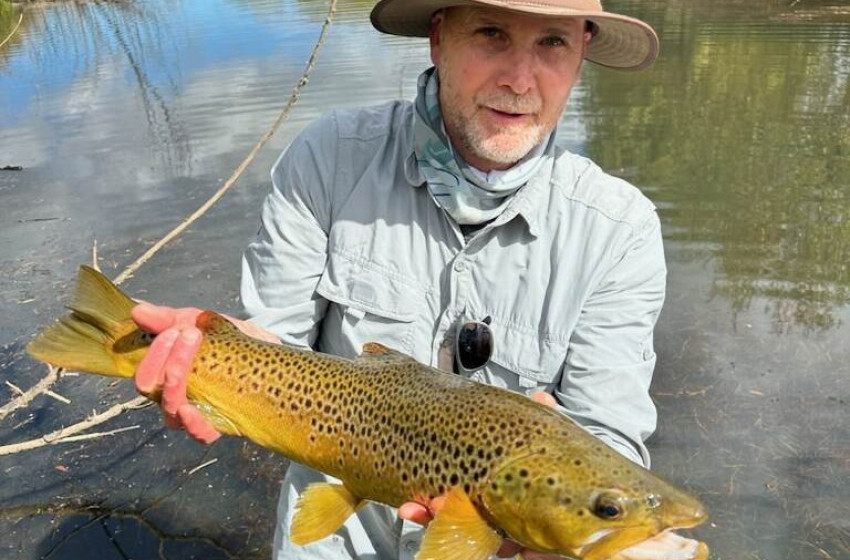
Autumn gold: Rivers are fishing their best
Welcome to the Otago edition of Reel Life for March.
Image above: Bruce Quirey with a brown trout that took a corixa fly pattern on the Taieri River. Credit: Mike Teasdale
We’ve had a great start to autumn, with warm, calm conditions and rivers flowing at lower levels. Autumn is a fantastic time to fish around the region, with more settled weather patterns. At this time of year, brown trout will begin congregating around river mouths before pushing upstream into spawning reaches, offering anglers a different seasonal opportunity.
Otago Reel Life is a compilation of highlights from recent Otago Weekly Fishing Reports. Read below for how to sign up for your weekly fishing news.
The Otago Weekly Fishing Report is published free weekly on Thursdays during the main fishing season.
- If you haven’t subscribed, you can click here.
- The weekly report will be emailed to your inbox with up-to-date fishing conditions, weather and river flow information to help improve your catch.
- You’ll also get a behind-the-scenes look at the work Otago Fish & Game does for our licence holders.
- You can catch up on previous regional reports on the Fish & Game website: Regional Fishing Reports - Tagged with Otago
Here’s a taste of what you may have missed in our recent weekly fishing reports:
Two casts then you’re out
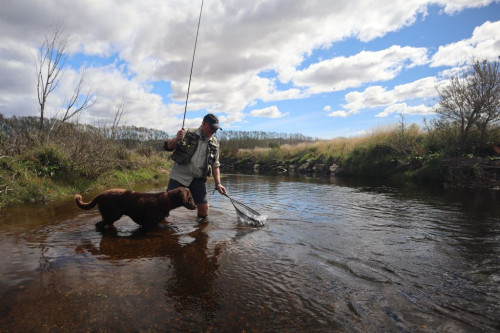
Mike Teasdale nets a trout that took a parachute Adams dry fly on the Taieri River at the weekend under the close eye of Duncan. Credit: Bruce Quirey
Make your first cast count.
Trout were spooky in low flows on the Taieri River a fine autumn day.
Mike Teasdale and Bruce Quirey enjoyed a day fly-fishing to sighted fish that consistently went shy if the first couple of presentations weren’t perfect. Bright, mostly calm conditions called for long leaders and careful approaches.
Casting from a high bank, they watched a solid-sized trout close its mouth on Mike’s parachute Adams dry fly, not once but twice, but on both occasions the hook didn’t stick. From the same pool, Bruce landed a 4-pound brown that rushed a corixa pattern after he gave the fly a twitch. Mike, accompanied by his canine buddy Duncan, later fooled another smaller brown on the Adams.
The rest of the day was about the ones that wouldn’t be tempted, with only a few mayfly duns seen, the odd adult damselfly, and sporadic rises. Patience and accuracy are needed — and don’t be afraid to move on if a fish won’t cooperate.
Streamer success

Cole Briggs with a great brown trout caught on a lightly weighted streamer in tight conditions. Photo supplied.
Changing up methods proved to be the key to success for Fish & Game staff member Cole Briggs on a day off.
Cole spotted a brown trout rising to terrestrial insects in a large pool. He initially tried a dry fly, cycling through several patterns without success. He then added a nymph dropper. Despite presenting a full smorgasbord of options all while trying to remain hidden, the fish continued feeding unconcerned. Finally, Cole switched tactics again and tied on a lightly weighted streamer. Two casts later, bang, he was hooked up in tight, bushy water with little room to move. After a short but tense fight, and one broken rod tip later, the fish was landed, quickly photographed, and released.
Cole’s hot tip, not the broken one, is to allow lightly weighted streamers time to sink when fishing them on a floating line before starting your retrieve. Often counting out loud can ensure you give it the appropriate time to sink.
Also, when landing fish on a fly rod or light spin gear, be careful to avoid point loading the rod tip. This occurs when the rod bends too sharply back on itself and often results in breakages just below the second guide. It can be avoided by gripping further down the rod, using a long-handled net, or fishing with a mate.
Maniototo reservoirs

Maniototo reservoirs at the weekend. Credit Steve Dixon
With a just a few weeks of the season remaining, be sure to make the most of our fine fisheries.
All the Maniototo reservoirs checked by a Fish & Game ranger at the weekend are full, however, few anglers were seen about. Trout were cruising and rising to midges around the edges.
While the Taieri River was low and clear, anglers at Daisybank were having success on small veltic lures.
Lennox’s first trout
Lennox Nitis with his first trout, which was caught on the Taieri River last weekend. Credit: Sarah Nitis
Every angler remembers the first trout they caught.
For 13-year-old Lennox Nitis, that moment came at the weekend after he’d bought a rod with his pocket money just days earlier. His mum Sarah took Lennox and his mate Mason Johnson to the lower Taieri River to give it a go.
Lennox credits Mason with helping him get started.
“He was good at teaching me how to set everything up,” Lennox says. “He’s quite good at fishing. He does quite a bit.”
The pair began fishing soft baits at a couple of angler access points but had no luck at first. Still determined, they moved to another spot and changed tactics — using worms dug out of tree logs.
Then Lennox felt a tug on the line and landed this wee brown trout.
“It was my first fish!
“I’m real keen to catch another one.”
Nice work, Lennox. Here’s hoping it’s the first of many trout and a lifetime of exploring our rivers and lakes.
River mouths rewards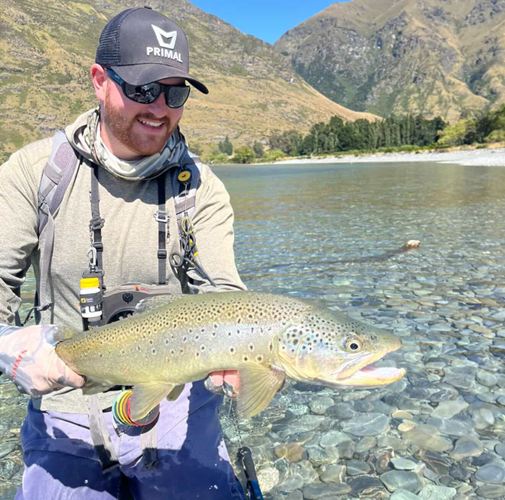
Tim Johnson with a chunky brown trout caught near one of lake Wakatipu’s many river mouths. Credit Kevin Johnson
River mouth fishing in autumn is nothing new to many anglers. At this time of year, fish often congregate around the drop-offs near river mouths, staging before their spawning runs and taking advantage of the influx of food coming down the rivers.
Tim, from Hunting & Fishing Central Otago, recently reported some excellent fishing around several of Lake Wakatipu’s river mouths. While fish numbers in the lower river that he initially intended to fish appeared slightly down, there were in fact large numbers holding just off the river mouth or cruising the lake edge nearby.
These fish can be effectively targeted from both boats and the shore. Jigging the drop-offs can be very productive, while casting small spinners or soft baits into the shallows and retrieving them back toward the drop-off and deeper water can also work well. Shore-based anglers can use the same approach by casting out and retrieving through the deeper edge.
Fly anglers can also do well using streamers or dry-dropper setups. One particularly effective technique is fishing a booby fly on a sinking line and retrieving it slowly along the drop-off.
A reminder for boat anglers: anglers fishing from a boat being propelled by a motor must stay at least 100 metres away from anglers fishing from the shore.
Hard going on the Pomahaka

Drew Couper chucking loops on the Pomahaka River. Credit: Jayde Couper
Fish & Game staff member Jayde Couper recently took his brother Drew to the Pomahaka in search of the legendary Clutha sea-runs.
Unfortunately, they didn’t find any, and while the resident fish were impressive, they were very tough to fool. On a hot windy day with cicadas blaring away, it was hoped that the fish could be drawn out of the deep dark pools with a cicada imitation, but no luck.
The odd fish out feeding in the shallows were easily spooked leading to a no-fish day — a reminder to lengthen your leader and take your time when fishing these pressured waterways. Despite this, the excellent company, scenery, and weather as well as a swim in the river at the end of the day, made the trip well worth it.
Remember, the upper Pomahaka above Hukarere station bridge is a Designated Water meaning that you need an additional licence endorsement to fish this area.
Low flows on large rivers

The Deans Banks section of the Clutha/Mata-au river is a popular fishery in low flows.Credit Mason Court
Lower flows on large rivers often help concentrate fish, as the amount of suitable holding water decreases. This can make it easier for anglers to identify and focus on productive sections. The Upper Clutha River, particularly the Deans Bank section, is a great example of this.
As temperatures cool and daylight hours shorten, mayfly hatches can occur steadily throughout the day, while caddisflies tend to emerge in the evenings. On calm days, anglers can experience fantastic surface action, with trout eagerly rising to drifting insects.
There is also the added benefit that lower flows can make the river more accessible. Areas that were previously too deep to wade may now be reachable, often providing better positioning and a decent back cast where it may not have been possible before.
A reminder that the Deans Bank section of the Clutha is fly fishing only and is marked by yellow and black marker posts. Outside of these markers, both spin fishing and bait fishing are permitted.
There are plenty of other larger rivers that anglers often rule out because they are normally too swift or too deep. With flows currently lower, it’s a good time to give some of these waters a try—you might just be surprised at what you find.
Click here for more information on the upper Clutha River/Mata-Au.
After-work success
 Sam Fisher with a lovely brown trout from the Kawarau River. Photo: Henry McCook
Large rivers close to town are often overlooked, with anglers choosing to travel further afield. However, they can provide excellent fishing, as the team from Queenstown Hunting & Fishing recently discovered on the Kawarau River just outside Queenstown. Henry and Sam got into quality fish during a quick after-work session, with Henry landing a solid rainbow on a size 16 Parachute Adams, while Sam hooked a strong brown from one of the deeper pools on a soft bait.
When time is limited, it can pay to carry both spinning and fly gear. If there’s no obvious insect activity, switching to spin fishing can make the most of the opportunity.
A popular and easily accessible stretch of the Kawarau is the Shotover Delta, offering good water above and below the confluence with the Shotover River for anglers to explore.
Click here to explore Fish & Game access points and find the closest waterways to your city or town.
Long-term uni study helps fishery management

Otago Fish & Game ecologist Jayde Couper (centre) electric-fishes Lindsay Creek with University of Otago students Isabella Fernie and Theo Head.
Otago Fish & Game helped University of Otago students electric-fish Lindsay Creek in February as part of annual research into the fish population in the Water of Leith and its tributary. While most fish are measured, recorded and released unharmed, some are kept for more detailed analysis. Data from the nine-year uni project helps us manage the fishery.
Juvenile trout numbers in the catchment vary from year to year but are resilient. The long-term study has shown autumn floods allow upstream migration to spawning sites, but big floods in winter and spring can lower juvenile trout numbers.
One 2025 student study using isotopic analysis of trout eye-lenses suggested that fish in the upper reaches primarily originate from sea-run females.
As a high proportion of trout in the system may come from fish that have spent time in the tidal reaches and harbour, we believe enhancing the river’s lower reaches could improve the overall fishery.
Fish & Game appreciates the chance to work with the university, both the expert freshwater ecologist on staff and the students — our future scientists.
Electric fishing with Te Kura O Take Kārara

One of many brook char caught during a recent electric fishing demonstration. Photo: Cole Briggs
Otago Fish & Game staff recently ran an electric fishing demonstration for Year 5/6 students from Te Kura O Take Kārara in Wānaka as part of their annual camp week.
The demonstration focused not only on assessing the fish population, but also on examining stream habitat — including substrate composition and surrounding vegetation — and how these factors contribute to a healthy waterway and why these are important.
It was an excellent day in the field, with students gaining hands-on insight into freshwater ecology and the team capturing stunning brook trout from a small local creek, which were released after some measurements and photos.
Key dates
March 29: Women’s Dunedin Fly Fishing Workshop with Women On the Fly and Otago Anglers Association. Register here: https://wotfnz.short.gy/Dunedin-Intro
April 1: Winter licences available from April 1 to September 30.
April 30: Final day of the Otago low country fishery season.
May 2: Opening day of the 2026 game bird season.
May 31: Final day of the Otago high country fishery season.
Check this season’s regulations for open seasons, permitted methods and daily bag limits for each individual water. Note several waters in Otago are open all year to fishing: Otago 2025-26 Sports Fishing Regulations.
Don’t Forget Your Licence
Get your licence online or visit a local agent.
Click the link for a list of the agents in Otago where you can buy a licence.
- Looking for places to fish? Check out this link: Where to Fish — Otago
- The ORC Environmental Data Portal is an excellent tool for monitoring flow levels.
Want more info? Check out these links or contact our helpful Otago team.
- Otago Fish & Game, 5 Hazlett Road, Mosgiel
- Tel: (03) 477 9076
- Email: otago@fishandgame.org.nz
Tight lines,
The team at Otago Fish & Game
Disclaimer:
The information presented in these news items is based on the context and regulations in place at the time of publication. Please note that some articles may include reference to laws and regulatory standards that have since changed. For the most current and accurate information please check our Fishing Licences & Regulations pages or our Hunting Licences & Regulations pages.