Reel Life November 2025 - Central South Island
- Central South Island
- 20/11/2025
Kid’s Fishing Day 2025
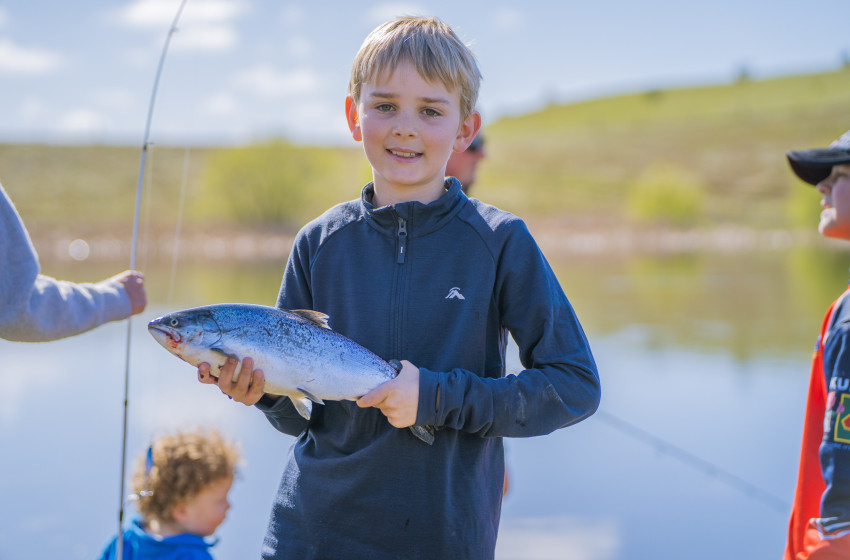
The first Saturday of November marked the Kids Salmon Fishing Day in the CSI region, which was held at Loch Cameron.
Image above: Oliver Currell with his salmon fresh out of Loch Cameron on Kid’s Fishing Day’ Photo by Braided Creative
This year, 87 young anglers between 4 and 11 and their families attended and gave salmon fishing a go. The catch rate was excellent with more than 100 salmon caught by lunchtime.
It couldn’t have been done without our sponsors and volunteers, the major sponsor being Mt Cook Alpine Salmon gifting over 300 salmon for the event. These were safely transported and delivered by Mackenzie Supply Services. Check the video of the fish drop-off here.
Spot prizes were generously donated by Shaw’s Hardware, Southern Alps Outdoors, Hunting and Fishing Timaru, Meridian Energy and Kilwell Sports. Every child went home with a fishing-related prize such as a lure, tacklebox or voucher.
There are still salmon available in Loch Cameron, so take a child or junior angler out over the next few weeks while this opportunity lasts.
We encourage anglers to keep salmon caught in Loch Cameron, up to the daily bag limit of 2.
The recommended lures are blue or pink with silver. Fish the deep between the two peninsulas and change direction every few casts to find them.
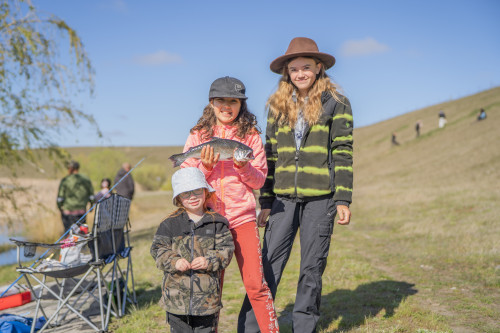
Sun-smart Willow (3), Luna and Sapphire (10) and their salmon. Photo by Braided Creative
Quick fishing ideas for December
- December is a great month for targeting sea-run brown trout at river mouths and lagoons – use life-like ‘smelt’ soft baits.
- Target perch at Clearwater or Emma using small bright lures.
- Fish the evening/night-time caddis rise on the Waitaki River near Kurow.
- Target sockeye salmon in the depths of Lake Benmore – see the video here for tips.
- Bait fish with worms, shrimps or huhu grubs at lakes Tekapo / Takapō, Pūkaki or Ōhau.
- Check out a new spot this December – find some inspiration from our access map by clicking here and watching the how-to video here.
- Bait fish with worms, shrimps or huhu grubs at lakes Tekapo / Takapō, Pūkaki or Ōhau.
Do be aware that it’s bird nesting season so please stick to formed tracks when four wheel driving on riverbeds.
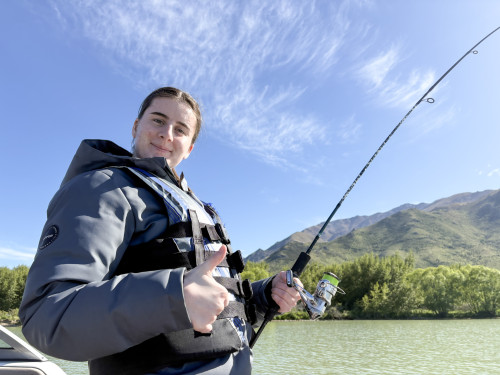
Grace poses for a photo while trolling Lake Benmore. Photo supplied by Jackson from NC
Match the hatch - Beetles!
It’s important to choose a fly based on what’s abundant in nature at the time. Imitating items that the fish are already keyed into and expecting to see makes them less likely to think twice about taking your fly.
Judging by the brown beetle parties going on in my bathroom this week, it’s prime time for the beetle imitation flies.
Brown beetles, the adult form of the grass grub, are very clumsy fliers, often crash landing on the water making an easy meal for a trout on warm nights.
We found this black beetle (pictured) last week on the Rangitata River and had some fun picking out flies that might best imitate it.
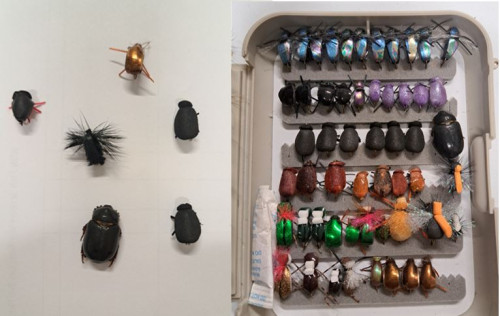
Rangitata River black beetle and his synthetic counterparts
Tench, the other coarse fish
As the water starts to heat up, “coarse fish” like tench are becoming more active and the next couple of months are a great time to target them.
If you want to try something different in our region, I’d recommend giving tench fishing a go.
They can be found most notably in Island Stream near Maheno, and also Centennial Park in Timaru.
Dedicated coarse anglers use a 12 ft rod helpful for steering fish away from snags, but a standard spinning rod will still do the trick.
Tench have a very soft mouth, so a small, barbless hook about size #14 is recommended. If your hook has a barb you can crimp it easily with pliers.
Add a small light sinker and sweetcorn or bread for bait. Tench are bottom dwellers and will root around in the silt, so that’s where your bait should sit. Like all fishing, once you get weed on your bait, the fish won’t take, so check it periodically.
“Ground bait” the area little and often, throw about six pieces near your hook every 5 minutes.
A float/indicator helps you see when the bait is taken. When the float dips below the water, set the hook with a gentle lift, like picking up a coffee. This doesn’t require a big action due to their delicate mouth tissue.
It’s important to note that these baits and methods (ground baiting/berley) are only permitted in “Coarse fishing waters”.
In Central South Island, the coarse fishing waters are; Centennial Park Lake, Saltwater Creek, Island Stream, and Waiareka Creek. See the regulation guide here.
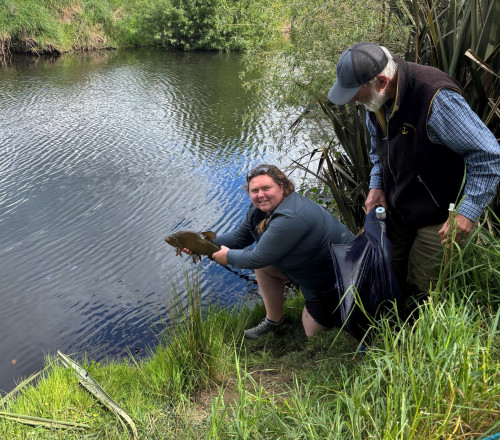
Tench from Island Stream caught last weekend.
Summer reminder: Handle with care
As summer kicks in and water temperatures rise anglers need to be extra mindful of the way that any fish intended to be released are handled.
Here’s our ‘Quick 5’ tips for handling fish with care:
- Cool your hands and landing net by wetting them before touching the fish.
- Keep the fish in the water while removing the hook.
- Do not squeeze the fish and never touch the gills.
- Photograph the fish in or over the water, and make it quick – the fish should not be out of the water for more than 5 seconds.
- Revive the fish facing into the current long enough for it to regain its swimming strength.
In the unfortunate instance that a fish you intended to release does end up bleeding from the gills, or does not recover completely, so long as you can legally take that fish, you should keep it as part of your bag limit and utilise it.
Sea-Run Salmon: 2025/26 Regulations and Spawning Estimates
The first sea-run salmon is often caught this month, so now is a great time to familiarise yourself with this season’s regulations.
The 2025/26 season bag limit for sea-run salmon in North Canterbury and Central South Island has been reduced to one fish. This means, season bag card holders may only harvest one sea-run salmon for the entire season.
This change was made under the joint Adaptive Management Strategy for setting North Canterbury and Central South Island sea-run salmon fishing regulations.
The 2025 sea-run salmon live spawning estimate fell below 1,200 fish, the threshold of the severe population management band and associated one fish season bag limit. (see table).
The 2025 spawning count (live fish) estimate for the North Canterbury and Central South Island Fish & Game regions are as follows:
|
Catchment |
Total Adult Spawners |
|
Waimakariri |
213 |
|
Rakaia |
608 |
|
Rangitata |
79 |
|
Combined total |
900 |
These combined spawning numbers represent the lowest recorded spawning population across the three key salmon catchments, demonstrating a new low point in the current salmon crisis. Of particular concern, the number of spawners counted in the Rangitata in 2025 were at only 4% of the historic average spawning run.
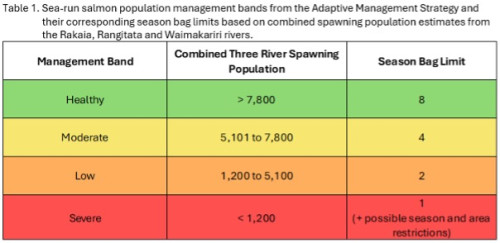
Table displaying the management bands and the associated bag limits for the CSI & NC regions.
Sea-Run Salmon FAQ’s
Find a full list of FAQ’s on our website here but some common ones we have had recently are:
Q: How does the sea-run salmon season bag work with a family licence?
Each whole season (resident) licence is eligible to obtain a sea-run salmon licence.
A family licence is one licence and can be issued only one season bag limit card.
Only one of the persons named on a family licence may harvest one salmon for the season. This will be entered on the season bag limit card and then all persons named on the family licence must stop fishing for sea-run salmon for the season.
Q: What if both family licence adults are fishing in different locations?
Only the licence holder carrying the season bag card or fishing at the same specific location as the season bag card, may fish for sea-run salmon.
If family licence members fish for sea-run salmon at the same time in different locations, the licence member who is not carrying the salmon bag card will not be able to comply with the relevant ‘Second Schedule’ regulations:
- Immediately upon taking or killing sea-run salmon the angler must complete an entry in their season bag limit card for that fish.
- Your season bag limit card must be produced to a ranger on demand.
Q: Can I continue to catch and release sea-run salmon after harvesting one sea-run salmon?
No, You must stop fishing for a sports fish after reaching the bag limit for that species.
In the case of sea-run salmon season bag limit, that means you must stop fishing for sea-run salmon for the remainder of the season.
Tight Lines,
Nikki Dellaway, CSI Fish & Game
Disclaimer:
The information presented in these news items is based on the context and regulations in place at the time of publication. Please note that some articles may include reference to laws and regulatory standards that have since changed. For the most current and accurate information please check our Fishing Licences & Regulations pages or our Hunting Licences & Regulations pages.