Reel Life November 2025 - Otago
- Otago
- 20/11/2025
Adapt and Thrive Through the Ups and Downs
Welcome to the Otago edition of Reel Life for November.
All freshwater fisheries in Otago are now open for the 2025-2026 season — with high country waters having opened on November 1. Summer is just around the corner.
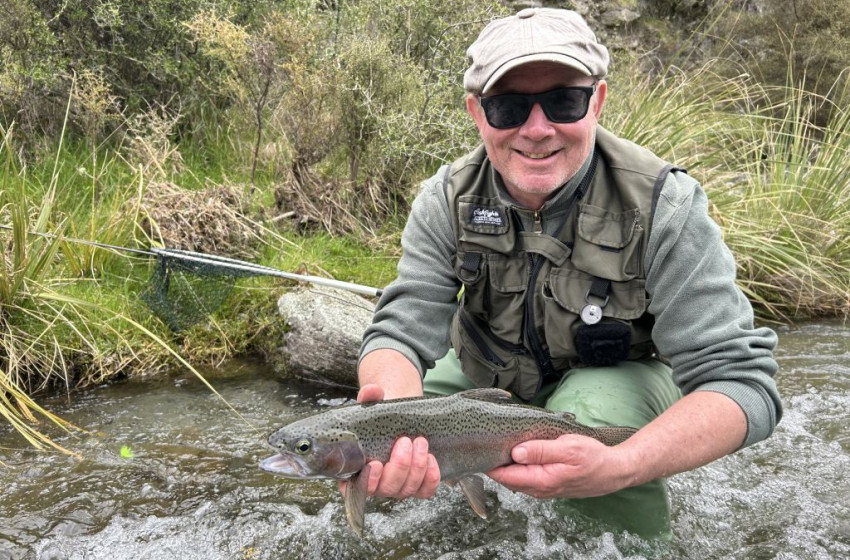
Image above: Jeff Briggs with a high-country rainbow. Photo: Cole Briggs
Spring has brought a mix of ups, downs, and rapid changes to river and lake conditions. Anglers who’ve adapted their plans around the weather have reported plenty of success from our rivers and lakes. From backcountry streamer runs to coastal action on baitfish and emerging beetle hatches, there’s plenty of action as the season warms up.
- Looking for places to fish? Check out this link: Where to Fish — Otago
- The ORC Environmental Data Portal is an excellent tool for monitoring flow levels.
- Before you head out, be sure to check this season’s regulations: Otago 2025-26 Sports Fishing Regulations.
Please note: Otago Reel Life is mostly a compilation of highlights from recent Otago Weekly Fishing Reports. Read below for how to sign up for your weekly fishing news.
Soft Bait Fishing Clinics
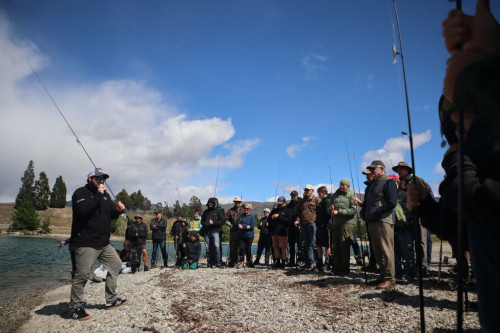
Lance Gill, from OKUMA, demonstrates soft bait fishing at Lake Dunstan. Photo: Bruce Quirey
About 160 extra Otago anglers have the knowledge and skills for soft-baiting with confidence this season thanks to hands-on clinics in Dunedin and Cromwell this month.
An overnight dusting of snow on Pisa Range provided a scenic backdrop for Otago Fish & Game’s soft bait clinic on the shore of Lake Dunstan in Cromwell on November 15.
About 85 anglers learned tricks and tips at McNulty Inlet with guest speaker OKUMA New Zealand pro-angler Lance Gill. The free clinic covered the essentials of soft bait fishing — rods, lines, soft bait lures, knots, rigging, and casting and retrieving techniques. A few participants then fished along the lake edge — and there was at least one tale of “the fish that got away” — dropping off the hook right at an angler’s feet.
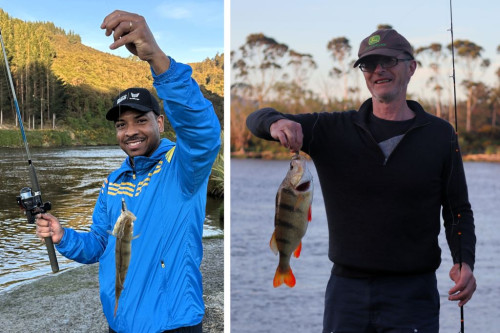
Diego Frizon (left) caught a perch on his first cast, while Richard Stephenson landed an excellent one during the Otago Fish & Game soft bait clinic at Titri. Photos: Bruce Quirey
The Cromwell session followed our other soft bait clinic at the Taieri River in Dunedin a week earlier — where 75 attended. Diego Frizon won’t forget his first cast at the Dunedin session. He hooked a perch on a soft bait having just picked up a rod for the first time in his life.
Thanks to all the participants, Lance and the Fish & Game staff and volunteers for making the clinics a success.
Welcome to the ‘Shoffice’
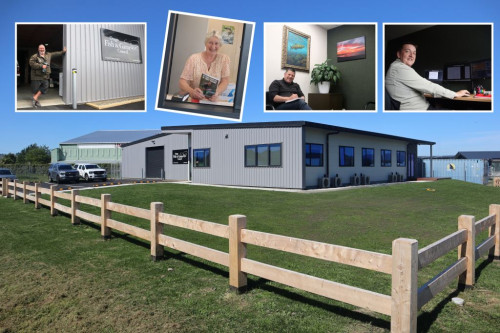 Is it a shed? Is it an office? At the new Mosgiel building are (from top left) Fish & Game officer Steve Dixon outside the workshop, Sharon Milne at reception, chief executive Ian Hadland, and ecologist Jayde Couper. Photos: Bruce Quirey
Otago Fish & Game is up and running in our new headquarters at 5 Hazlett Rd, Mosgiel.
The move took place late last month and reflects a future-focused, financially responsible approach to delivering better value for fishing and hunting licence holders. Our old Dunedin premises is closed.
Proceeds from the sale of our Dunedin site funded a new building that’s modern, practical, and fit for purpose — with little extra cost to reserves.
The new single-storey building brings office, workshop, and storage spaces together under one roof. It features level entry access for all visitors, on-site parking, and facilities tailored to the needs of a small team and field operations. Six Otago staff are based at the Mosgiel office and three at our Cromwell field base.
Our headquarters are also closer to the places where most fishing and hunting action occurs.
It’s a busy time of year for staff with fish liberations, soft bait fishing clinics, audits, resource consents, club events, and reporting. A Mike Weddell fly-fishing course has begun in the new premises. Councillors look forward to using the new boardroom at their next meeting on December 2.
Otago Weekly Fishing Report
The Otago Weekly Fishing Report is published free weekly on Thursdays during the main fishing season.
- If you haven’t subscribed, you can click here.
- The weekly report will be emailed to your inbox with up-to-date fishing conditions, weather and river flow information to help improve your catch.
- You’ll also get a behind-the-scenes look at the work Otago Fish & Game does for our licence holders.
- We’re also offering a new section, Club Updates, connecting you and local fishing clubs.
You can catch up on previous regional reports on the Fish & Game website: Regional Fishing Reports - Tagged with Otago
Spring Streamers
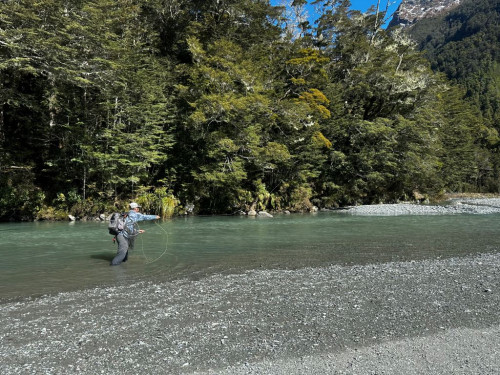
Adam Walton working a nice-looking run in Otago backcountry. Photo: Lowell Smyth
Backcountry anglers will need to adapt to the conditions with what looks like a return to the weather pattern that brings rain every three or four days.
Adam Walton and Lowell Smyth recently made the most of a brief window of clear weather, enjoying a successful backcountry trip on a dropping river after the last rain. Adam found great success fishing streamers, his go-to technique when rivers are coloured or receding.
Streamers can range from bright pinks to subtle browns and greens. The key is matching the size and colour to your intended presentation: darker patterns create a strong silhouette in murky water, while natural tones offer a more subtle presentation.
“There’s nothing like the initial hit when a fish grabs a streamer,” Adam says. “It makes them incredibly fun to fish.”
The beauty of streamer fishing is its versatility. You can fish them effectively with a standard 5 or 6-weight set-up by adding a sinking leader or using a weighted fly. Don’t be afraid to step up your tippet size either, as fish often hit hard and the extra strength helps prevent break-offs, especially when the water still has a bit of colour.
World’s Best Trout Fishing
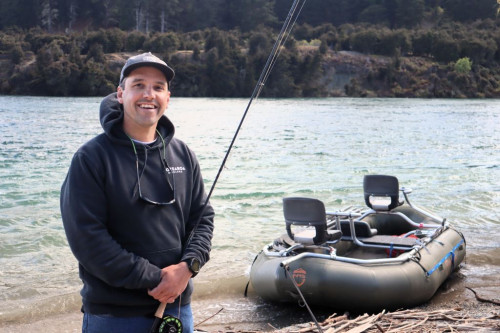
Lake Hawea-based guide Jeff Forsee says sight fishing for trout in New Zealand’s high country is something special. Photo: Bruce Quirey
Before the high-country fisheries opened, we caught up with Lake Hawea-based guide Jeff Forsee to talk about the economic and health benefits of trout fishing — and what fishing means for him personally.
Jeff, who has fished around the world — including guiding in Alaska and Mongolia — firmly believes New Zealand offers the world’s best trout fishing.
“New Zealand's very much on the radar for international trout anglers,” Mr Forsee, who runs Aotearoa Anglers, said.
Most of his fishing clients are American or Australian, but others come from all over the world. Sight-fishing for trout in New Zealand’s high country is something special, he said.
Hunting the Edges
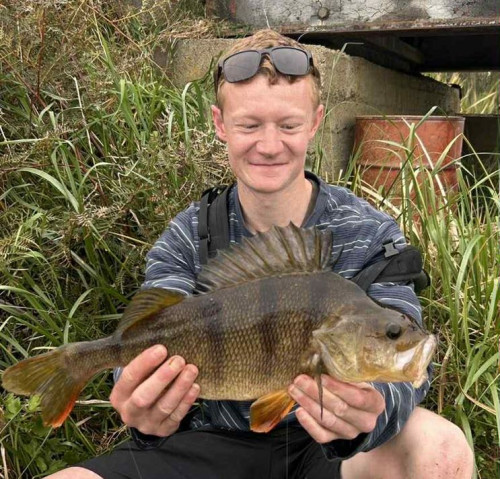
Hadlee Edmunds with an excellent perch caught softbaiting the Waipori River. Photo: Supplied
Brown trout and perch have switched on along the lower east coast rivers, aggressively feeding on schools of small baitfish, says Hadlee, from Hunting & Fishing Dunedin.
Imitating the small whitebait-sized baitfish is the key to getting bites, with larger spinners and softbaits often ignored. He’s been finding success using the 2.5-inch Copper Flash Bait Junkie, which closely replicates the size and flash of current baitfish. Customers have also had good results using small streamers.
In the lower reaches, it’s not uncommon to see sportsfish chasing baitfish into the shallows, creating splashes and bust-ups as they feed. Casting along the edges, where these predators often lie in wait, is usually the most effective approach. Working your lure slowly along the margins to mimic a lost baitfish can prove irresistible to perch and trout.
Coastal sea-run trout make excellent table fare, and perch are also known for their firm, white flesh. Pack a chilly bin with ice to make the most of your catch as conditions start to warm.
Success on Lake Margins
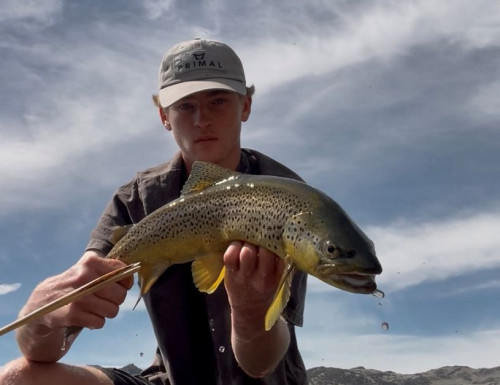
Lachlan Dent with a brown trout caught up the top end of Lake Dunstan. Photo: Supplied
Racing rain clouds have been a major factor this spring. Tim, from Hunting & Fishing Central, found this out the hard way on his last day off, arriving at a river that had already started to rise and discolour. More rain was beginning to fall. A quick change of plans was required. Fortunately, Otago has stillwater fisheries, allowing anglers to pivot if needed.
Tim found success targeting cruising fish around the edges of Lake Hāwea, using small dries and nymphs to intercept them. He says fishing in a pair really helps, with one angler spotting fish from a higher vantage point while the other casts near the water’s edge.
Popular areas for cruising fish include Paddock Bay (Lake Wānaka), The Neck (Lake Hāwea), and the top of Lake Dunstan where the Clutha flows in.
As the weather warms, blowfly patterns become a favourite along lake edges, with a small size 14 pheasant tail suspended below often proving irresistible. Giving your fly or nymph a little movement can trigger a strike when using smaller flies. Just be careful not to make the movement too exaggerated or unnatural, as this can spook the fish. Practising your presentation when no fish are present can help you fine-tune the action.
Beetlemania
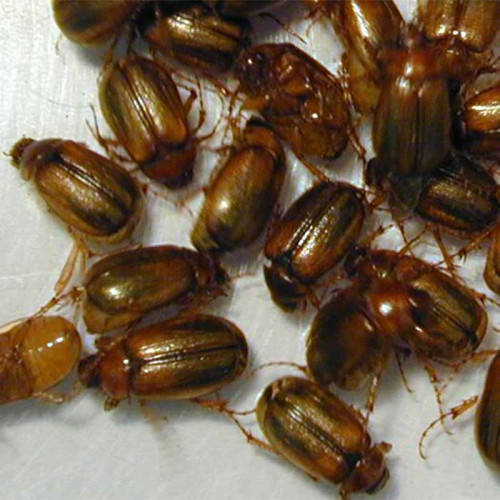
Brown beetles are turning up on the trout menu right on cue in the angling calendar. Rising soil temperatures trigger the seasonal emergence of the brown beetle. The beetle is common near pasture and grassland, as their larvae (grass grubs) eat grass roots.
- The Fly: The classic Coch-y-Bondhu is an ideal imitation. Other good imitations use deer hair or foam.
- Timing: The most significant beetle 'falls' onto the water occur at dusk as the clumsy beetles take flight, and again at dawn as they drop from streamside vegetation.
- Presentation: A heavy beetle pattern should land with a distinct "plop" to imitate the natural crashing onto the surface.
- Location: Fish near grassy banks and willows, particularly where drowned beetles accumulate in foam lines and eddies.
Don’t Get Caught Out This Summer — Check Your Boat ID
The 2025 QLDC Navigation Safety Bylaw introduces new vessel registration requirements aimed at improving identification, safety, and accountability on the district’s waterways.
For motorised vessels, this means displaying an identifying name or number above the waterline on each side of the vessel. Commercial vessels already registered with Maritime New Zealand or those with a registered VHF radio call sign can use their approved names or numbers.
For most recreational boat owners with trailer-borne vessels, the new rules require displaying the registration number of the trailer above the waterline on each side of the vessel. The identification must be at least 90 millimetres high and readable from a distance of 50 metres.
These rules are similar to those already in place across the rest of Otago under the ORC Navigation Safety Bylaw, which can be viewed here.
Please note that non–power-driven vessels under six metres in length are exempt from the vessel ID requirements. However, it is recommended that all vessels — even those not required to display identification — are marked somewhere with the owner’s name and contact details to assist in case of loss or emergency.
Otago Anglers Association — 142nd Waipahi Gold Medal
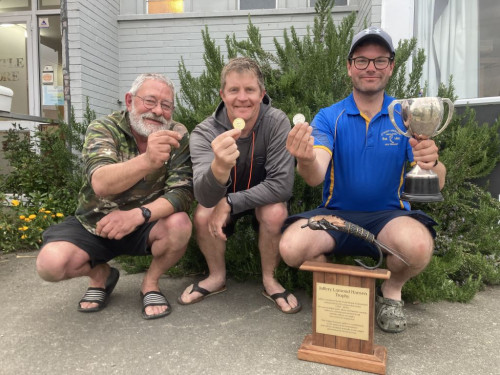
The medal winners from the 142nd Waipahi Gold Medal are Matt Pettersson - gold (middle), Dan Natta – silver (right), and bronze Shane Hansen (left). Photo: Bruce Quirey
Only about a teaspoon separated gold from silver in the 142nd Waipahi Gold Medal on November 1. Top honours went to Matt Pettersson, nudging out Dan Natta by only 5 grams more in fish weighed in.
Early rain on Friday gave the Waipahi River a slight rise in flow, greeting anglers with coloured but steadily clearing water on Saturday morning. True to reputation, the Waipahi proved challenging with few fish seen or caught across the beats. Despite the conditions, 19 fish were weighed in and the winners fully earned their recognition for skilful angling.
The Otago Anglers Association thanked the contestants, landowners who provided access, and event sponsors for continued support. Otago Fish & Game staff were on-site collecting trout otoliths (ear bones) from the weigh-in — research that helps determine where fish have lived during their life cycle and supports management of key spawning streams within the lower Clutha/Mata-Au catchment.
Otago Fish & Game Engagement Survey
You may have received an email this week from Otago Fish & Game for our annual Engagement Survey. We’re conducting a quick survey to see how we’re tracking — to improve our service for your fishing and game bird hunting experiences. You may have received a similar survey in recent years. We’d appreciate your input.
Thanks for your participation!
Teviot Angling Club — Take A Kid Fishing Day
- Teviot Angling Club is running a Take A Kid Fishing Day this Sunday, November 23.
- Remarkables Orchard, Awaikiki Road, Roxburgh East
- Start 8.30am (Please do not enter the property before 8.30am.)
- Inquiries contact secretary.teviotanglingclub@gmail.com
Don’t Forget Your Licence
Buy early to get best value for the 2025-2026 season. Get your licence online or visit a local agent.
Click the link for a list of the agents in Otago where you can buy a licence.
Event Calendar
Click here for upcoming fishing events throughout New Zealand.
Want more info? Check out these links or contact our helpful Otago team.
- Otago Fish & Game, 5 Hazlett Road, Mosgiel
- Tel: (03) 477 9076
- Email: otago@fishandgame.org.nz
Tight lines,
The team at Otago Fish & Game Council
Disclaimer:
The information presented in these news items is based on the context and regulations in place at the time of publication. Please note that some articles may include reference to laws and regulatory standards that have since changed. For the most current and accurate information please check our Fishing Licences & Regulations pages or our Hunting Licences & Regulations pages.