Otago Weekly Fishing Report - 05 February 2026
- Otago
- 5/02/2026
Options aplenty this Waitangi Weekend
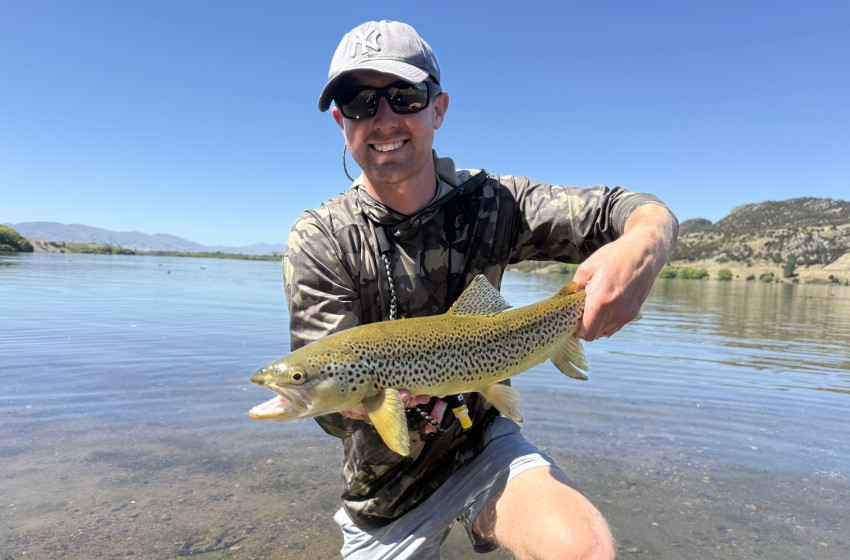
Cole Briggs with a brown trout caught patrolling the weed edges on Lake Dunstan. Photo: Mason Court.
This long weekend is shaping up as a great opportunity to get out across the region, with conditions lining up to offer a variety of fishing options.
Most rivers are dropping after the mid-week rain and are now sitting at levels suitable for a wide range of angling styles. One positive from the wet summer we’ve had is that many smaller waterways still have good flow and depth. These streams would normally be dropping away by now, but instead are still holding fish, offering some exciting opportunities.
The forecast is a bit mixed, with light showers and wind lingering at times, but these conditions can work in your favour. Focus on where terrestrial insects are being blown onto the water, look for sheltered bays where trout will be cruising, and use the extra wind and surface ripple to sneak closer and make that first cast count.
If you’re heading out this weekend and don’t yet have a licence, there are plenty of options available, from a day licence or short break through to a full season or family licence. Licences can be purchased online via our website or from one of our local agents. To get your licence or explore the options available, click here.
Don’t forget about damsels
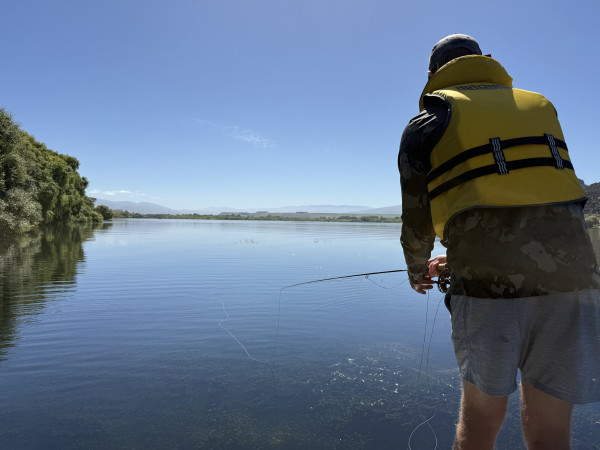
Cole Briggs watching a cruising trout approach his damsel imitation. Photo: Mason Court
As we move into February, many anglers start to focus on cicadas and the exciting fishing they bring. However, imitating adult and larval damselflies on our lakes, dams and reservoirs are often overlooked and can provide excellent and exciting opportunities.
Trout will frequently launch themselves out of the water to take adult damselflies, while others cruise the edges of aquatic vegetation where damselfly larvae live, searching for any larvae exposed in the open.
These cruising fish can be targeted effectively from both the shore and a boat. One of the key things to get right is the size and colour of your imitation. Damselfly larvae are most commonly brown or green, while adult dry fly patterns are often effective in blue or red variations. If you don’t have a specific damsel pattern, a sparsely tied, unweighted hare’s ear or pheasant tail nymph in size 12 or 14 can work very well.
Presentation is just as important as fly choice. Aim to land your fly just off the edge of the vegetation. Too close to the weed and the fish may not see it, too far out and it can look unnatural. Lengthening your leader can help with a subtle presentation, but be cautious about going too light on tippet. Once hooked, these trout often dive straight back into the weed. For this reason, when fishing nymphs it’s often better to use a small indicator rather than a dry-dropper setup, reducing the risk of an extra hook snagging in the weed.
Angler notice reminder
Every three years, we do a full review of the regulations that govern sports fishing in our region.
This review utilises biological data, angler usage trends, and compliance feedback to ensure regulations remain fit for purpose. This review has been completed and produced 17 proposed regulation amendments:
Region wide rule change proposals:
- Removing the Otago based exemption to allow continued fishing once having hit the bag limit, to simplify and align with other regions.
- Proposing to end the "zero bag limit" on the upper Lochy and Routeburn rivers.
- Removing rules about how many fish you can have in your possession when travelling between fisheries or fishing multiple days.
- Allowing soft baits and scented lures in any area where spin fishing is already allowed.
- Removing restrictions on treble and multiple hooks in Designated Waters.
Lower Clutha & Catlins:
- Tautuku Estuary: Proposal to officially list this area as a fishery that is open all year to boats and all fishing methods.
- Tahakopa River: Proposal to allow boat fishing and year-round access in the lower sections.
- Lower Clutha gear restrictions: A proposed ban on using gaffs to better protect fish, while removing the ban on using floats.
Central Lakes:
- Proposal to open Lake Dispute year-round.
- Close Diamond Creek during May to protect salmon during their spawning season.
- Remove Lake McKellar from the Greenstone Designated Waters and Controlled Fishery.
- Lochy River: Allocate the entire river as a Designated Water, aligning the upper and lower river rules.
- Lake Wanaka: Reduce the salmon bag limit from four to one.
Taieri & Leith:
- Leith regulations: A proposal to make the rules for the Upper Leith and Lindsay Creek the same as the Lower Leith.
- Upper Taieri: Reduce the bag limit from four to one in the upper Styx Basin.
Otago full season licence holders will have already received an email asking them to submit. If you didn’t receive this, it’s most likely we either don’t have your correct email address or you opted out of receiving information from us. Make sure to check on those next time you purchase a licence.
If you received the email from us but haven’t filled it out, please do so, as your knowledge and opinions will help shape the final recommendations to the minister.
If you are not an Otago licence holder or didn’t receive the email but still want to contribute, please follow this link
Waiting on cicadas
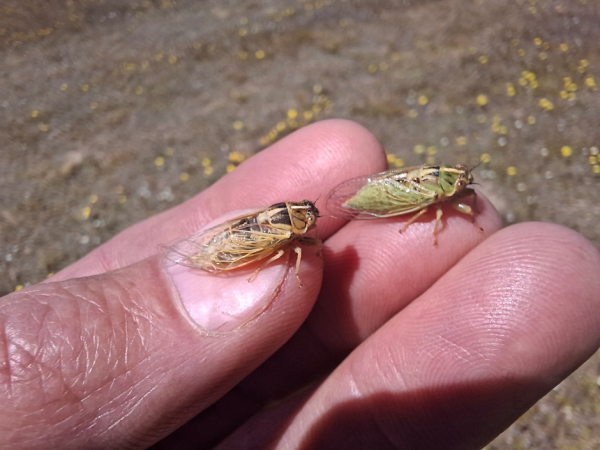
A pair of small cicadas observed by Otago Fish & Game staff during ranging on Wednesday into one of Otago Designated Waters. Credit: Jamie Ward.
The chirping of chorus cicadas among the tussock often signals a prime time for anglers, as both river and lake trout focus on these terrestrial insects as a preferred food source.
Despite a wet summer this year, reports indicate that cicadas are beginning to emerge at high-country reservoirs, lakes, and tussock-lined rivers.
With a spell of warm weather forecast for the coming week, it’s likely their numbers will increase. Early in the season, when only a few cicadas are present, it’s an excellent opportunity to target trout. Later, when cicadas blanket the water, trout often fill up and retreat to deeper water, and your fly needs to compete with a large number of natural insects.
Matching your fly to the correct size is important, as cicadas vary significantly in size and colour between areas due to different species. For example, the cicadas in the tussock-lined rivers above are often smaller and best imitated by a size 12 or 14 fly, whereas the larger cicadas found at Loganburn and other reservoirs are more effectively matched with a size 8 or 10 fly.
Pitstop for a perch
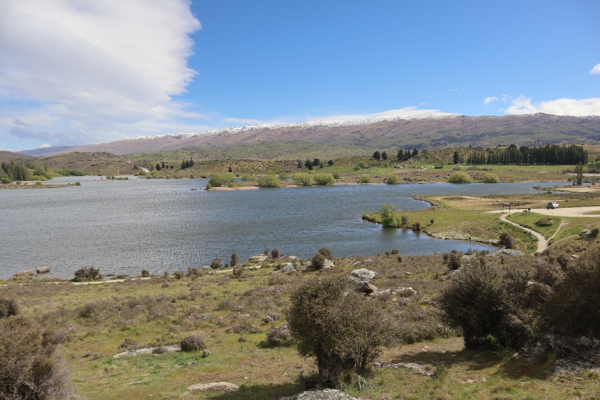
Butcher’s Dam offer easy access and close parking to an excellent perch fishery. Photo: Bruce Quirey.
Heading away this long weekend to Central Otago from the coast and looking for a good spot to stretch the legs? Butchers Dam is an ideal place to stop and flick a line.
It offers easy access from the shore, plenty of parking, and holds a healthy population of perch that are usually easy to find close to the edges. Butchers Dam is also one of the Otago dams stocked with rainbow trout from the Oceana McRaes Hatchery.
Over the warmer months, perch feed actively, making now a great time to target a tasty feed. Perch often school up and are generally easier to catch than many other sportfish, which makes them a great option for kids or anglers just starting out. Small, brightly coloured lures such as pink or chartreuse soft baits, or traffic light Tobies, are often very effective. Worms fished under a bubble float are another reliable option. If you’re catching a lot of smaller perch, try upsizing your lure to a larger perch imitation as the larger fish are cannibalistic. Don’t forget that perch are excellent eating with lovely white flesh if looked after well so don’t forget some ice or frozen water bottles to keep your catch cold.
Central Lakes acoustic surveys
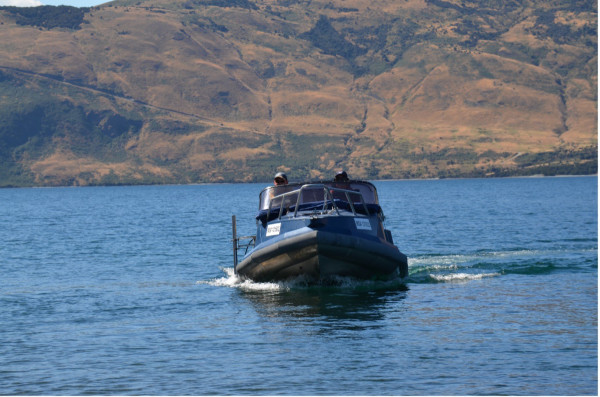
Staff completing acoustic surveys last year up Stevensons Arm on Lake Wānaka. Note the extended pole which has the larger-than-normal transducer mounted on it. Photo: Mason Court.
Next week you might notice the Otago Fish & Game vessel OFG7 zigzagging along the edges of the larger lakes, don’t worry, our steering isn’t broken!
This week we’re conducting acoustic monitoring of fish populations in lakes Wakatipu, Wānaka and Hāwea.
This marks the fourth consecutive year of this survey, helping to establish a valuable baseline for future comparisons. Using a high-tech echo sounder, staff are collecting vast amounts of data, which will be analysed and reported to the Otago Fish and Game Council in the coming months.
The Council has made it a strategic priority to understand the drivers behind changes in trout and salmon populations and to establish long-term monitoring for the Southern Lakes fisheries.
To read last year’s report, click here.
Don’t forget to check, clean, dry this long weekend

Across Otago, the Check, Clean, Dry programme is working hard to protect our waterways from invasive freshwater pests like hornwort and lagarosiphon.
These pests can easily travel on wet gear, boats, or even the soles of your shoes, ending up in your favourite lake or river and damaging the places you love to fish, swim, or paddle. With the long weekend approaching, many people will be moving around the region.
The solution is simple: before moving between rivers and lakes, check your gear for debris, clean it thoroughly, and dry it completely. It’s small steps that make a big difference.
Once invasive species take hold, they’re almost impossible to remove. They can smother riverbeds, disrupt food chains, and impact tourism and local communities. Prevention is our best defence, and it starts with each of us. By taking a few minutes to Check, Clean, Dry every time, you’re helping protect the unique beauty, biodiversity and angling opportunities of Otago’s lakes and rivers. Together, we can keep the region pristine for everyone to enjoy.
For more information on Check, Clean, Dry, click here.
Henry’s snail-type wet fly
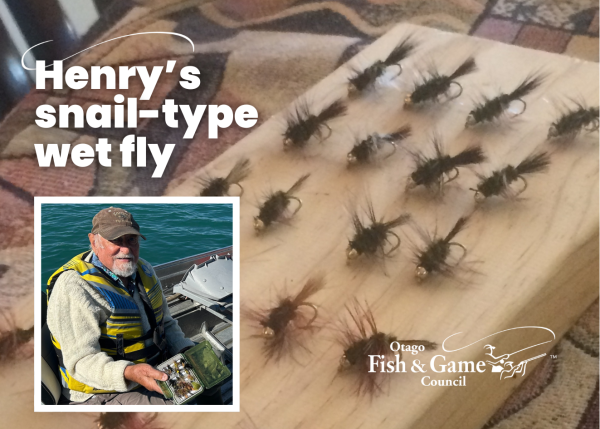
Cromwell fly angler Henry Smith targets Lake Dunstan trout with a snail-type wet fly pattern.
When Cromwell angler Henry Smith receives his freshwater fishing licence next season, it will be his 80th. It’s a gift from his family each year, marking a lifetime spent chasing trout and refining his art.
Henry has fished Lake Dunstan regularly since the dam was built in the early 1990s and says he’s spent more time on the lake than most. He’s quietly confident of landing trout most outings, but says patience remains the most important skill — no matter how experienced you are.
One of Henry’s preferred methods in Dunstan is casting wet flies towards the weed beds or harling. He ties his own flies, with a favourite pattern imitating the large aquatic snails found grazing on lake weeds. This fly is essentially a Woolly Bugger-type pattern with a gold bead and stiff tail.
When harling, Henry uses a short section of lead line to get his sinking fly line down to the correct depth, keeping the fly just above the weed tops where trout are actively feeding.
Henry’s snail-type wet fly
- Tail: Black squirrel
- Body: Olive-brown chenille
- Hackle: Palmered red-brown saddle feather
- Head: Gold bead
- Hook: Size 6 or 8
Lake Hāwea Family Fishing Classic

The Lake Hawea Family Fishing Classic is on this Saturday the 7th of February.
You can download registration forms for a Family or an Individual.
Entry Forms are also available from the Lake Hawea Community Centre the day before competition (Friday 6th February): Between 5 pm and 10 pm or the morning of the competition day between 7am and 9am
- Weigh-inbetween 2 pm – 4 pm on competition day – At the Lake Hawea Community Centre.
- Prize giving from 6:30 pm at the Lake Hawea Community Centre.
Fly fishing course
Learn fly casting, tackle, trout behaviour, what trout eat, flies that imitate that food and how to fish them.
These 2-hour sessions over four evenings with Mike Weddell will also cover how to read the water, and how to fish rivers and stillwaters.
- March 9, 16, 23, 30, from 7 pm - 9 pm
- Otago Fish and Game office, 5 Hazlett Road, North Taieri, Mosgiel
- Contact Mike Weddell 027 577 2439 or mike@mikeweddellflyfishing.co.nz
Club updates
If your Otago club has an update or photo for inclusion in the Weekly Fishing Report, please email bquirey@fishandgame.org.nz by the Monday prior to publication on Thursday.
Don’t forget your licence
Get your licence online or visit a local agent.
Click the link for a list of the agents in Otago where you can buy a licence.
Event calendar
Click here for upcoming fishing events throughout New Zealand.
Lake Hāwea webcam
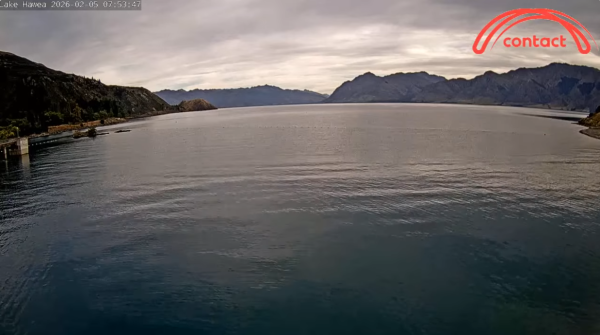
A screengrab of the Lake Hāwea webcam taken at the time of writing.
A real-time webcam at Lake Hāwea is provided by Snowgrass Solutions and Contact Energy and can be accessed through their website or directly via this link.
Please note conditions at the southern end of the lake (near the dam) may not always reflect those north of The Neck. Weather can change quickly, so be prepared.
Clyde Dam live webcam
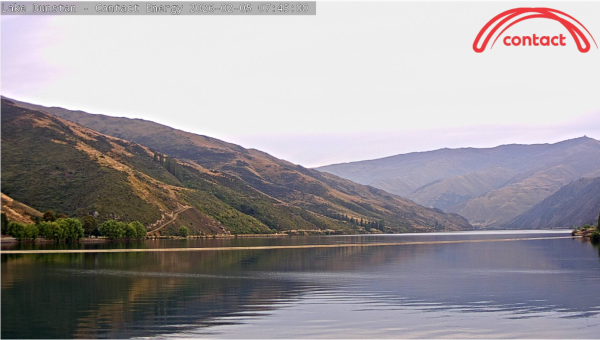
A screengrab of the Clyde Dam webcam taken at the time of writing.
Want to know conditions at Clyde Dam? Check this live webcam sponsored by Contact Energy, updated every 15 minutes.
Lake Wānaka live webcam
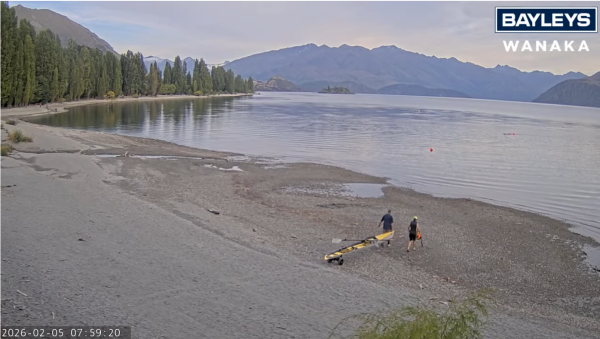
A screengrab of the Lake Wānaka webcam taken at the time of writing.
Want to know conditions at Lake Wānaka? Check this live webcam from the Wānaka Watersports Facility.
Bookmark the ORC Environmental Data Portal for real-time flows, temperature, and lake levels.
Here’s the weekend outlook:
Dunedin
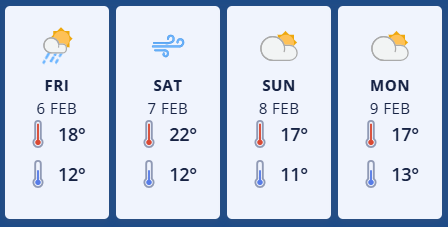
An excellent start to the long weekend is forecast for Dunedin, with overnight showers clearing on Friday morning. Clear skies and light southwesterly winds are expected early, shifting to a northeast breeze in the afternoon. Saturday is also forecast to be fine, though northwesterlies are expected to strengthen as the day goes on, so making the most of the calm morning conditions will be key. Sunday looks more unsettled, with overcast conditions, scattered showers, and southerly to southwesterly winds developing.
The Taieri River at Outram was at 26 cumecs this morning. The water temperature was 16.6 degrees C.
Click here for live MetService weather updates.
Wānaka
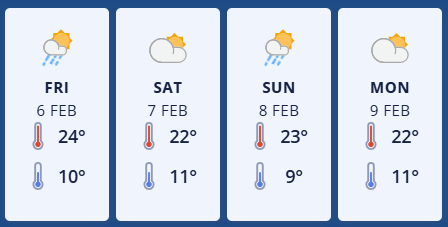
Thursday night showers are forecast to clear by Friday morning, with light winds and clear skies, making Friday an excellent day to fish. Seek out fast-dropping rivers or head out on the lakes, both offering good options. Saturday is expected to be overcast with the odd shower, so make the most of the calm morning before north-west winds strengthen. Sunday will bring a few showers clearing through the day, with light winds again providing favourable conditions for anglers.
Click here for live MetService weather updates.
Alexandra
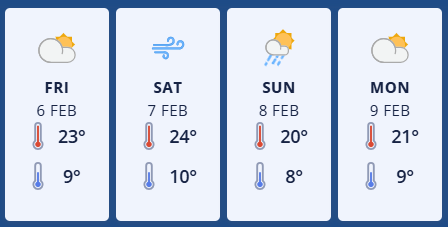
Friday is forecast to be mainly fine around Alexandra, with northerlies turning westerly during the afternoon. On Saturday, winds are expected to strengthen, with fresh north-westerlies, so finding a sheltered bay or switching to spin tackle may be the key to success on the high-country rivers and dams, and if cicadas are around it’s worth considering where they’re likely to be blown onto the water. Sunday is forecast to bring occasional rain, clearing to fine in the morning, with southerlies easing later in the evening.
Click here for live MetService weather updates.
Clutha regional forecast
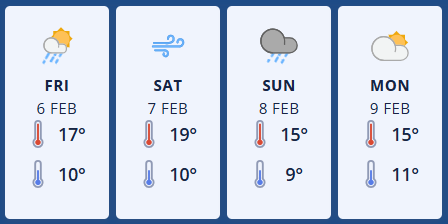
A slightly wet start to the long weekend is expected for the lower Clutha, with showers clearing Friday morning. Saturday will be overcast, with showers developing in the evening and strong north-westerlies. Sunday will bring cooler temperatures, with some heavy showers clearing in the morning but skies remaining cloudy, and south-westerlies easing by evening. One thing to note is the Clutha River / Mata- Au has dropped below 400 cumec so should remain fishable even through the rain.
The Pomahaka River at Burkes Ford was at 9.2 cumecs
The lower Clutha River at Balclutha was 392 cumecs.
Click here for live weather updates.
For more ORC water monitoring and alerts information click here.
Grab your licence online and let the angling adventures begin.
Got any Otago fishing news?
Send your fishing news and photos (with anglers’ names) to otago@fishandgame.org.nz for consideration in the weekly report.
Disclaimer:
The information presented in these news items is based on the context and regulations in place at the time of publication. Please note that some articles may include reference to laws and regulatory standards that have since changed. For the most current and accurate information please check our Fishing Licences & Regulations pages or our Hunting Licences & Regulations pages.