Otago Weekly Fishing Report -18 December 2025
- Otago
- 18/12/2025
Merry Christmas and tight lines
Merry Christmas and Happy New Year from the Otago Fish & Game team! We hope you spend some time relaxing with friends and family on our amazing fisheries this holiday season and that the weather plays along.
There will be no Otago Weekly Fishing Report next week. Updates will resume on January 8. To stay informed over the holidays, please follow our Facebook page, which will continue to be updated with news and information.
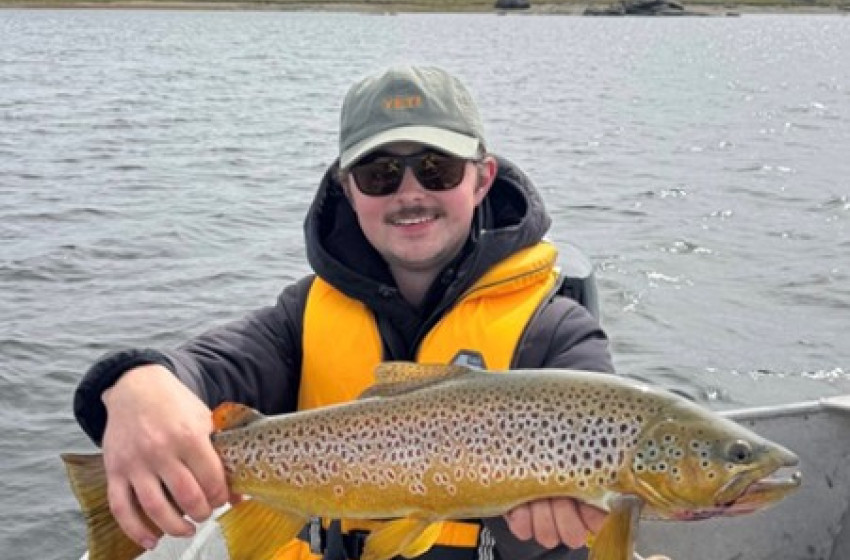
Dan Kunac with a stunning conditioned and coloured brown trout caught fishing from the boat at Poolburn Reservoir. Credit: Casey Golden.
Last weekend provided warm, settled weather across the region, offering excellent angling conditions on lakes and rivers. Pink Tasmanian Devils were the lure of choice for many anglers on Lake Hāwea, resulting in some fine salmon. If cared for properly, these should make excellent table fare for Christmas.
Other anglers, such as Dan Kunac from Dunedin, ventured up to Poolburn Dam to target the stunning-coloured trout for which the reservoir is famous. Although the fishing was slow, success was had using soft baits along the shore and dull-coloured lures while trolling.
With the rivers expected to receive a top-up of rain followed by settled weather, lakes and rivers should remain in excellent condition for anglers over the holidays.
Hotspots on the large lakes
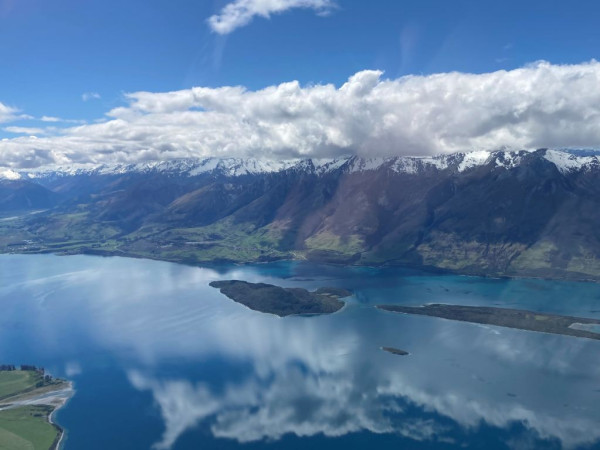
Lake Wakatipu provides a variety of productive locations.
The large lakes of Central Otago are popular with holidaymakers and anglers, offering a wide range of fishing opportunities from the shore and by boat.
On Lake Hāwea, productive shoreline areas include The Neck (between Wānaka and Hāwea), the Timaru River mouth, and the shoreline around the campground. Boat anglers often find success working the river mouths of the Hunter, Dingle, and Timaru rivers, where fish patrol drop-offs and current lines.
Lake Wānaka offers excellent boat fishing in areas such as Stevensons Arm, along with the Matukitukiand Makarora river mouths. Shore-based anglers can do well at Paddock Bay, the Lake Wānaka outlet, and around the Matukituki mouth and adjacent shoreline, particularly during low-light.
Lake Wakatipu provides a variety of productive locations, especially where rivers enter the lake. Well-known shoreline spots include Twelve Mile, Twenty-Five Mile, the Greenstone River mouth, and the Dart and Rees deltas, where anglers are reminded to take extra care —soft edges can collapse, sweeping you into deep, frigid water. Boat fishing is often most effective along drop-offs near inflowing rivers or lake outflows. Popular areas include Frankton Arm, Kingston near the Devil’s Staircase, and the upper lake around Glenorchy.
Access points across the entire Otago Region can be explored via our access map here
Getting in the zone
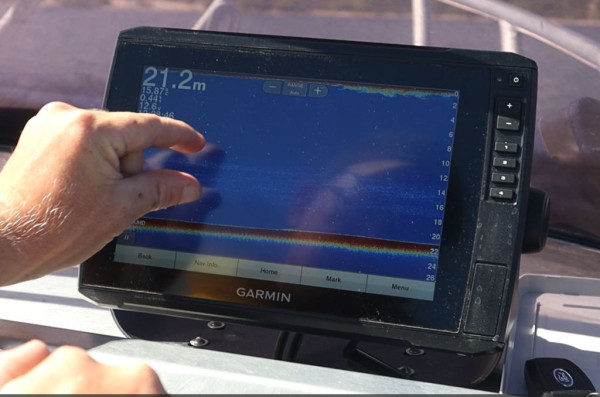
The thermocline will appear as a horizontal line or a fuzzy band running across the screen of your fish finder.
A lot of anglers will be heading to Otago’s lakes and rivers for an extended break to hopefully take advantage of warm, calm and clear weather. During the warmer months, we often hear anglers talking about fishing the thermocline in the lakes.
The thermocline is the layer of water where the temperature changes rapidly from warm to cold. Trout often congregate near the thermocline in lakes as it offers a balance of temperature and oxygen levels.
Use a fish finder sounder to identify the thermocline, appearing as a horizontal line or a fuzzy band running across the screen.
You’ll often see fish arches near or just above the thermocline.
Trolling: use a lead core line, paravane or downrigger to reach the thermocline. Follow the shoreline using the fish finder to stay in the thermocline.
Jigging: Drop a weighted jig head lure to the desired depth and use short, subtle lifts of the rod to impart action to the jig.
Watch this Facebook video
Lake Dunstan creel survey
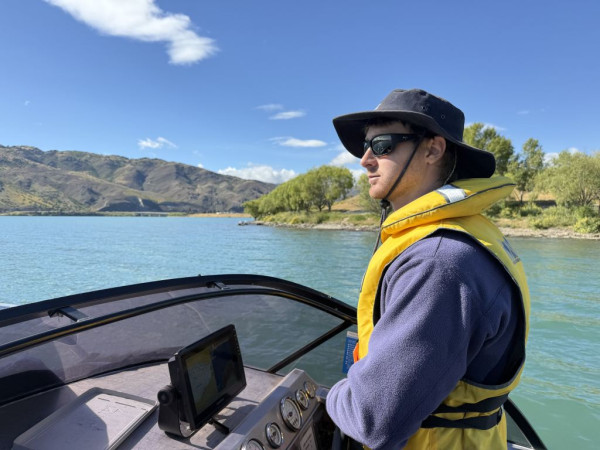
Otago Fish & Game officer Cole Briggs heads out on Lake Dunstan to do a creel survey. Credit: Mason Court.
If you meet a ranger while fishing on Lake Dunstan this season, don’t be surprised if you get asked some extra questions — all in the name of fisheries management.
Otago Fish & Game has begun creel surveys on Dunstan, making it the latest lake to be included in our fisheries monitoring programme. Over the past six years, creel surveys have focused on Lakes Hāwea and Wānaka, monitoring for three years on each one.
Creel surveys collect data on anglers’ catch rates and fishing activity, to help inform on the status of the lake fisheries. The face-to-face surveys on the lake are carried out by Fish & Game staff sometimes supported by our honorary rangers.
Rangers are also checking licences during the surveys.
Know your species
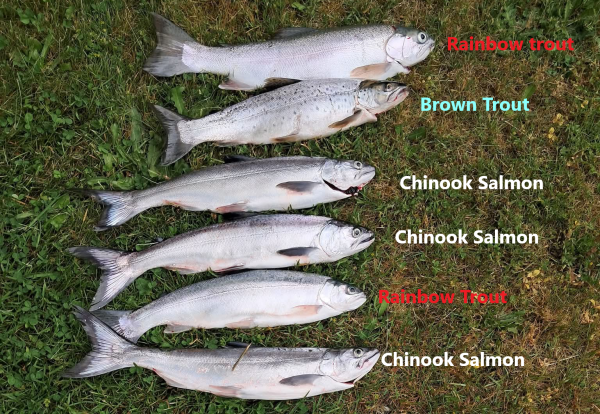
Trout and salmon, such as these caught in Lake Hāwea, often look similar.
Otago has a number of fisheries where different species of trout and salmon coexist — especially in our big lakes.
The photo above shows how easy it could be to misidentify species if you don’t know what to look for. It’s important to be able to identify your catch.
The key identifiers for the most commonly caught sports fish are the tail (caudal fin) and the anal fin, which is on the underside of the fish, just in front of the tail.
Follow the simple chart below to identify your fish.
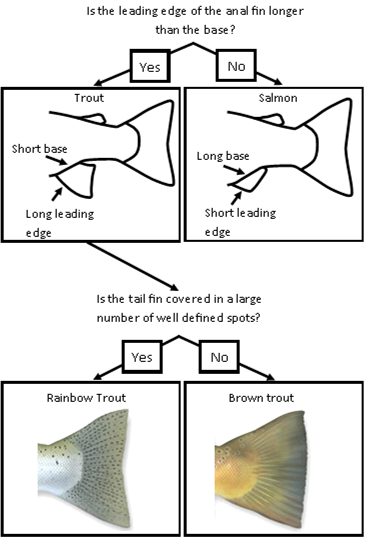
Trout and salmon live in lakes Hāwea, Wānaka, Wakatipu and Dunstan where the daily bag limit is two trout and four salmon. If you reach your limit of two trout but cannot positively identify the species, please carefully release any more fish.
This ID guide will also be useful for silvery trout and salmon caught in the lower Clutha River/Mata-Au.
Carry your licence, thanks
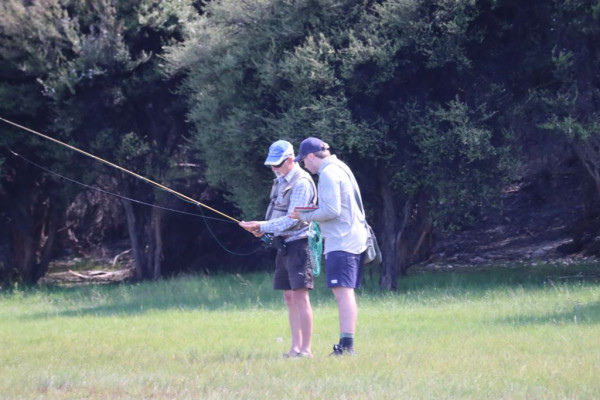
Fish & Game officer Mason Court chats with an angler while checking licences at Lake Wānaka.
Rangers will be out in force across the region over summer, not only checking licences but also offering helpful tips to improve anglers’ success and enjoyment on the water.
Staff and honorary rangers have recently completed training to help them stay aware of their surroundings and work safely during the busy summer season.
Our rangers train with CERT, situational safety and tactical communications experts who work with others in regulatory roles such as police, corrections, aviation and local government.
Anglers are reminded you’re required to carry a valid fishing licence.
If your physical licence has not arrived, a phone screenshot of your licence — along with a secondary form of identification — will be accepted. Screenshotting your licence is also a reliable way to keep a record, as email access can be limited in areas with poor mobile coverage.
Be prepared to present your fishing licence on request by a warranted ranger, thanks.
Happy visitor supporting economy
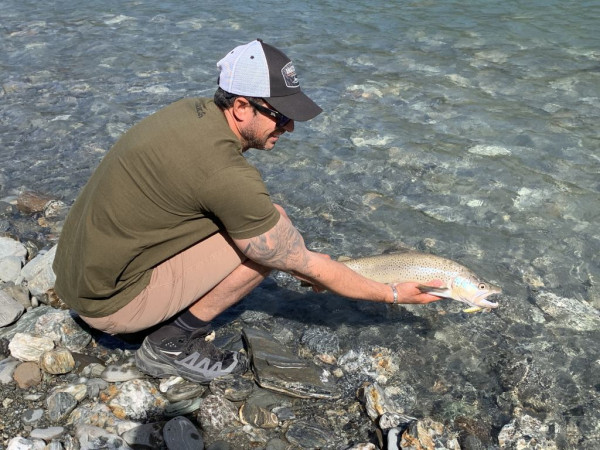
Luke Galea with one of his trout caught on minnow-style hard-bodied lures. Photo: Supplied.
We received a fantastic report and photos from Australian angler Luke Galea, who spent the past two weeks holidaying and fishing across multiple Fish & Game regions in the South Island. His successful trip goes to show the effectiveness of spin fishing with the right gear.
Luke caught several impressive trout on minnow-style, shallow-diving, hard-bodied lures.
"What an amazing fishery you have,” Luke says. “Caught some great fish and had the best time.
“I released all of my fish. I would have love to have kept one for the table, but as we were staying in motels etc, we didn’t really have the cooking facilities.
“I get a lot of satisfaction watching them swim away these days anyways! Keep up the great work. Can’t wait to fish New Zealand again.”
Each year anglers spend between $113 million and $139 million on their trips and contribute to about 1000 jobs nationwide, NZIER research shows. International visitors inject valuable tourism dollars into our rural and regional economies, spending an average of $340 a day.
Upper Clutha River still running high
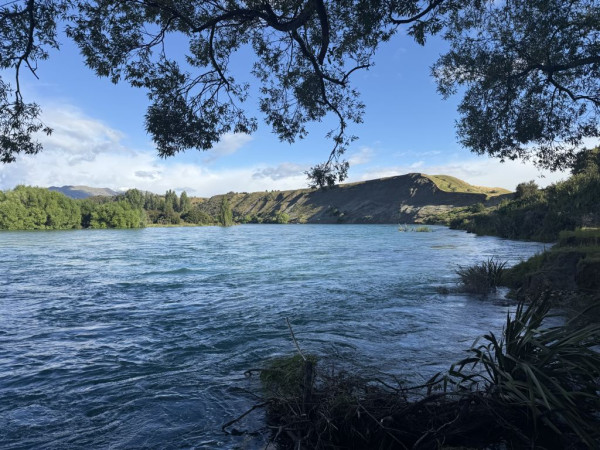
Deans Bank section of the Clutha River was still flowing high on Tuesday morning. Photo: Mason Court
The upper section of the Clutha River is still running at over 400 cumecs, which is considered high flow according to the ORC environmental data portal. For comparison, the median flow of the upper Clutha is around 280 cumecs.
These elevated flows are the result of significant rainfall through spring and early summer, which has also kept lake levels high.
Fly anglers fishing the Deans Bank section report success using streamers fished hard against the edges. Upstream of the fly-fishing-only areas, anglers are catching fish using soft baits and spinners swung across the current. With higher flows, smaller-profile heavy lures — such as Hex wobblers — and heavier jigheads paired with soft baits have also been effective.
Drift-diving in the high country
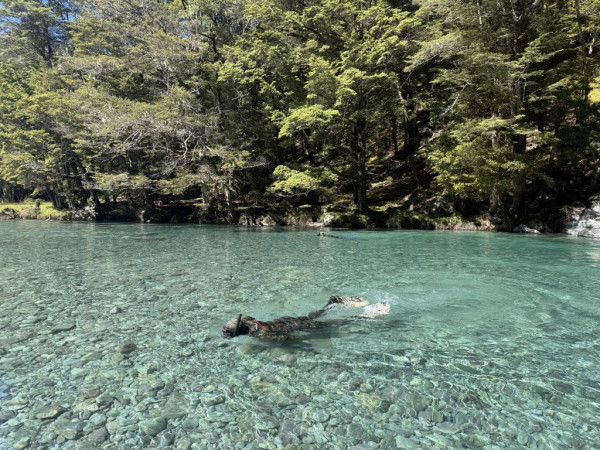
Otago Fish & Game staff drift-dive the Caples River last week to count and classify fish. Photo: Cole Briggs
Last week Otago Fish & Game staff conducted drift dives on sections of the Greenstone and Caples Rivers as part of the Designated Waters monitoring programme.
Low, clear river levels made for some bumps and bruises for the divers, but the cold water provided excellent counting conditions.
Preliminary observations showed larger brown trout favouring deep pools, while rainbow trout fed actively in riffles and at the tops of pools. One rainbow trout even followed the divers, taking advantage of disturbed macroinvertebrates. A positive highlight was the number of juvenile rainbow trout, around 100mm long, feeding in shallow riffles. Divers noted mayfly nymphs being dislodged in the rapids, with size 14 patterns being the closest match for anglers wishing to imitate them.
Fishing close to home
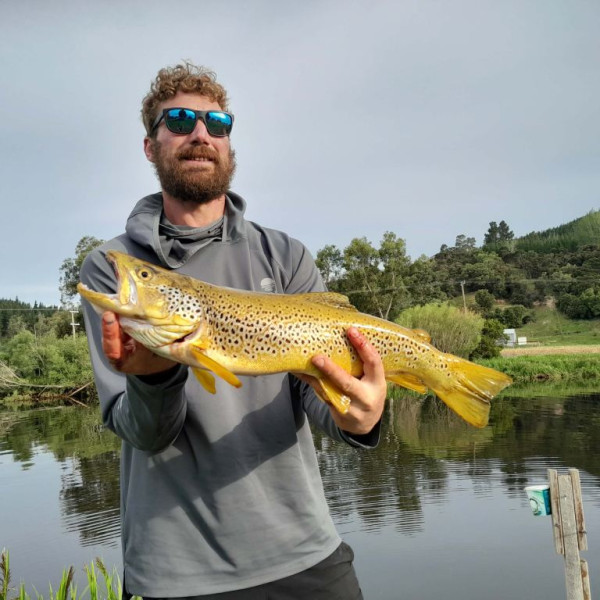
Reuben Tait with a 5-pound brown trout caught on a paddle tail soft bait on Sunday.
You don’t need to travel far to find good fishing these summer holidays. There are plenty of half-day fishing options within easy reach of Dunedin.
The lower Taieri River was fishing well for anglers last weekend — with some impressive trout and perch being caught, as well as kahawai near the river mouth.
Reuben Tait sent in a photo of a 5-pound brown trout caught on a paddle tail soft bait on Sunday.
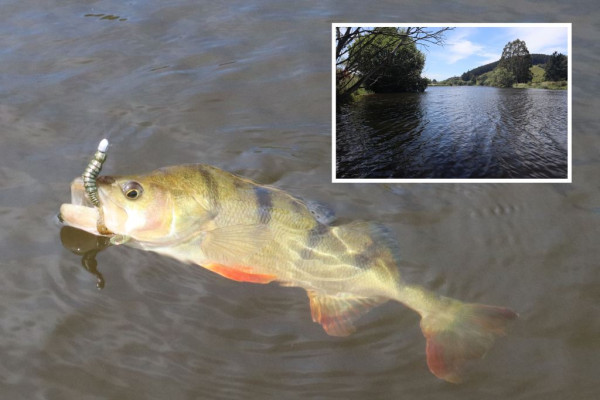
This perch chased down a grub-tail soft bait cast towards the edges in the lower Taieri River at the weekend. Photo: Bruce Quirey.
Brown trout were seen leaping after red adult damselflies hovering above the river. How successful they were at catching insects mid-air is another question.
Perch were also on the bite in the lower Taieri taking grub-tail soft baits. They made a welcome addition to the chilly bin — Sunday dinner was sorted.
Read more about Half a Day to Fish South of Dunedin
Ethical catch and release tips
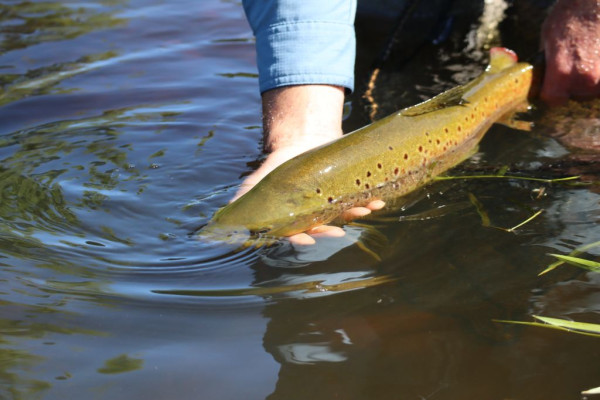
Support the fish's body and do not squeeze it too hard. Avoid contact with the gills.
When catching and releasing a fish — even after it swims away — there is a high chance it won’t survive if the fish has been mishandled.
A ranger last week reported seeing hand marks on an unhealthy fish that had obviously been mishandled by an angler.
To ensure the fish you release survive and thrive, follow these simple guidelines:
- Wet Your Hands: Always wet your hands thoroughly before touching the fish. Dry hands remove the fish's protective slime layer.
- Keep It Wet: Minimise the fish's time out of the water. Hold them over the water, especially when removing the hook.
- Handle Gently: Support the fish's body and do not squeeze it too hard. Avoid contact with the gills.
- Photo Quickly: If taking a photo, do it immediately and keep the fish lifted only for a moment. Never place the fish on hot or dry surfaces.
- Revive Properly: Hold the fish gently facing into the current until it vigorously kicks its tail and swims away.
Anglers Notice – triennial review
We are currently working through our full review of the Otago fishing regulations, a process that takes place every three years.
Shortly, every Otago Region full season licence holder with a registered email will be contacted with details on how to contribute and share their opinion on potential changes, so keep an eye on your inbox.
Club Updates
If your Otago club has an update or photo for inclusion in the Weekly Fishing Report, please email bquirey@fishandgame.org.nz by the Monday prior to publication on Thursday.
Don’t Forget Your Licence
Buy early to get best value for the 2025-2026 season. Get your licence online or visit a local agent.
Click the link for a list of the agents in Otago where you can buy a licence.
Event calendar
Click here for upcoming fishing events throughout New Zealand.
Lake Hāwea Webcam
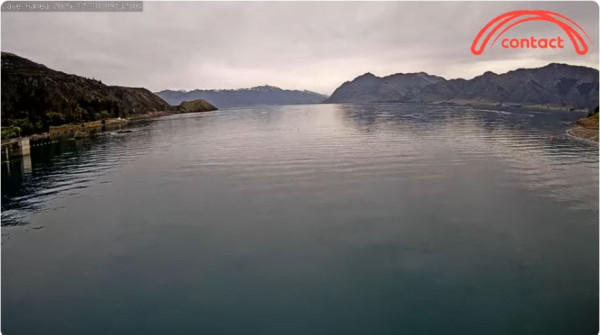
A real-time webcam at Lake Hāwea is provided by Snowgrass Solutions and Contact Energy and can be accessed through their website or directly via this link.
Please note conditions at the southern end of the lake (near the dam) may not always reflect those north of The Neck. Weather can change quickly, so be prepared.
Clyde Dam live webcam
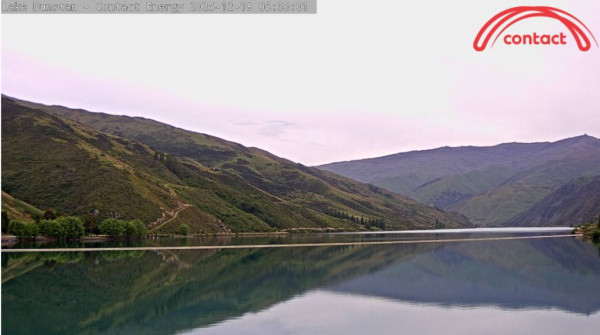
A screengrab of the Clyde Dam webcam taken at the time of writing.
Want to know conditions at Clyde Dam? Check this live webcam sponsored by Contact Energy, updated every 15 minutes.
Lake Wānaka live webcam
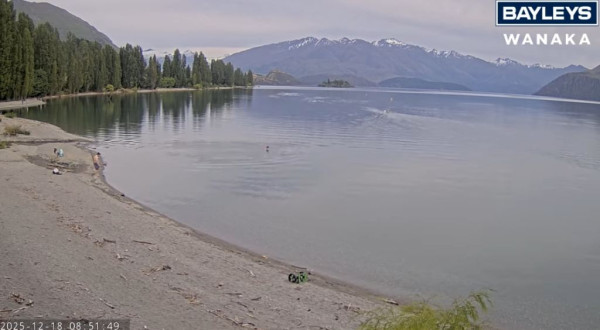
A screengrab of the Lake Wānaka webcam taken at the time of writing.
Want to know conditions at Lake Wānaka? Check this live webcam from the Wānaka Watersports Facility.
Bookmark the ORC Environmental Data Portal for real-time flows, temperature, and lake levels.
Here’s the weekend outlook:
Dunedin
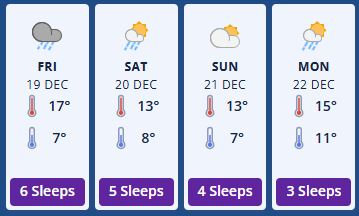
Showers and southwesterly winds are forecast for Dunedin this weekend, gradually easing each day. Sunday looks to be the more favourable day for angling, with winds and clouds clearing in the afternoon — ideal conditions for targeting trout or perch on the lower Taieri. Expect river levels to rise slightly and water temperatures to cool, ideal conditions for large flies, soft baits or streamers.
The Taieri River at Outram was at 11 cumecs this morning. The water temperature was 16 degrees C.
Click here for live MetService weather updates
Wānaka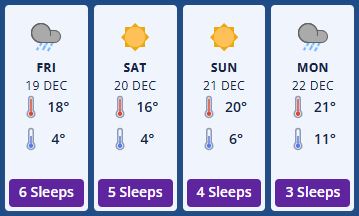
Friday’s rain showers followed by settled weather over the weekend are shaping up to make Wanaka a hotspot for anglers. Clear skies are forecast for both days. Sunday looks particularly appealing thanks to light winds and warm air temperatures climbing into the low 20s — ideal for fishing on lakes and rivers. Southerly winds are expected to develop before dawn on Saturday, so take that into account when planning your weekend.
Click here for live MetService weather updates.
Alexandra
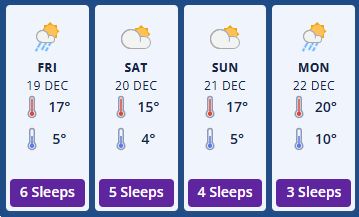
Make the most of calm mornings for fishing. Clouds are forecast to clear Sunday morning, with light winds creating ideal conditions for angling around the Alexandra area. Saturday morning is expected to be clear, though scattered showers and southwesterly winds will develop later in the day. River levels, including the Manuherikia, are expected to rise slightly following Friday and Saturday’s rain.
Click here for live MetService weather updates.
Clutha Regional Forecast
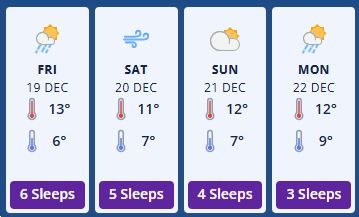
Sunday afternoon looks set to offer the best weather for angling around the Lower Clutha, with southerly winds easing and clouds clearing. However, rain showers and strengthening southwesterly winds are expected to develop as the day progresses. Recent rain from Thursday through Saturday will likely have raised river flows, so anglers should plan accordingly.
The Pomahaka River at Burkes Ford was at 8 cumecs this morning
The lower Clutha River at Balclutha was 840 cumecs.
Click here for live weather updates.
For more ORC water monitoring and alerts information click here.
Grab your licence online and let the angling adventures begin.
Got any Otago fishing news?
Send your fishing news and photos (with anglers’ names) to otago@fishandgame.org.nz for consideration in the weekly report.

Otago Fish & Game Council’s new office at 5 Hazlett Road, North Taieri, Mosgiel will close at 1pm on Wednesday, December 24.
We will reopen at 8am on Monday, January 5.
Any inquiries please email: otago@fishandgame.org.nz
Disclaimer:
The information presented in these news items is based on the context and regulations in place at the time of publication. Please note that some articles may include reference to laws and regulatory standards that have since changed. For the most current and accurate information please check our Fishing Licences & Regulations pages or our Hunting Licences & Regulations pages.